Enterprise AI is moving from chatbot, to agent, to specialized agents, to multi-agent systems — and multi-agent systems only become safe once they are governed.
A multi-agent system is not simply more agents. It is specialized intelligence coordinated across responsibility boundaries — research, pricing, contract review, risk, and execution held by different agents rather than one overloaded model. That raises a question no framework answers by itself: when several AI agents collaborate and reach a recommendation, who actually has the authority to make it a decision? This page argues that intelligence and authority must be kept separate — AI Agents generate Signals and Candidates; the Chinoba Decision Runtime finalizes Decisions through Policy, Boundary, Human Authority, and Command Permit — and traces the architecture from single agent to Runtime Society.
The practical guide behind this page's architecture. It works through why OpenAI Agents SDK, Claude Agent SDK, AutoGen, and LangGraph are not competitors but complementary Agent Frameworks covering different responsibility boundaries, why an Agent Framework can make an Agent capable without making an organization accountable, how the Chinoba Decision Runtime resolves Signals and Candidates into a Decision through Policy, Boundary, Human Gate, and Command Permit, and how Centralized, Cooperative Edge, and Federated Runtime architectures extend that governance from a single deployment to a Runtime Society.
View on Amazon → ASIN B0HFVVWTCJ · Kindle · Masao WatanabeThe practical guide above leads this line of inquiry. Below it are the neighboring Chinoba books, videos, and the essay on Multi-Agent Systems and AI Coordination that this page draws on and expands.
The Runtime OS and Multi-Agent Systems library — English and Japanese editions — plus the earlier Multi-Agent Coordination volumes this page builds on.
Visual introductions to Agent Frameworks, Multi-Agent Systems, Chinoba Decision Runtime Edge, and the Runtime OS architectures that govern them.
The long-form essay behind this page's argument, plus the earlier guides on multi-agent architecture and the AI agent economy.
Enterprise AI has been moving through a consistent progression — chatbot, to agent, to specialized agents, to multi-agent systems. The step this page is about is the one most comparisons skip: a multi-agent system only becomes trustworthy once it is governed.
Chatbot
↓ Agent
↓ Specialized Agents
↓ Multi-Agent Systems
↓ Governed Multi-Agent Systems
Multi-Agent Systems are not primarily about increasing how many AI Agents are running. They are about separating responsibilities — research, pricing, contract review, risk — while coordinating specialized intelligence toward one outcome.
Once several AI Agents research, propose, and even agree with one another, a question follows that no amount of additional coordination logic answers on its own:
            When multiple AI Agents collaborate,
            who actually has the authority
            to make the final decision?
That question is what leads this research from Multi-Agent Coordination into the Chinoba Decision Runtime.

Before comparing Agent Frameworks, it helps to see the enterprise problem that makes a single AI Agent insufficient in the first place. A quotation workflow is a small, concrete example of a pattern that recurs everywhere.
Customer Request
↓ Research
↓ Customer Data
↓ Pricing
↓ Contract Review
↓ Risk Evaluation
↓ Approval
↓ Execution
Put all eight of those steps inside a single LLM or a single AI Agent, and the failure is not that it cannot try — it is what trying does to the system:

Splitting the quotation workflow across Specialized Agents solves the context and reusability problem — and introduces a new one: Agent Coordination.
Customer Request
↓ research-agent
↓ pricing-agent
↓ contract-review-agent
↓ support-agent
Each Specialized Agent now has a narrower scope, a reusable role, and a boundary that can be reviewed on its own. But nothing yet decides who acts first, what happens when two agents disagree, or how a partial failure in one agent is recovered without corrupting the rest — that is what Agent Coordination has to add. A deeper walk-through of these coordination failure modes is in the companion Multi-Agent Systems & AI Coordination essay.
One agent passes control and context directly to the next agent best suited to continue — a relay, not a broadcast.
A central coordinator agent assigns work, resolves conflicts, and holds the overall state that individual agents do not see.
Agents are nodes in a predefined graph of steps and conditions — coordination as an explicit, inspectable structure.
Agents run as independent actors exchanging asynchronous messages — loosely coupled, individually restartable, and scalable.

Twelve structural concepts that compose a coordinated decision system — from intent, roles, and shared context, through runtime, negotiation, and resonance, to boundaries, human gates, decision traces, trust, and learning.
The goals, constraints, and stakeholder meaning that enter the system — the source from which all coordination derives its direction.
Differentiated capabilities and responsibilities — specialized participants, not interchangeable solvers, anchored to scope.
How intent is broken into sub-problems and routed across agents — the substrate that turns a goal into coordinated work.
The common memory, state, and signals that agents read and write — the connective tissue of distributed decision-making.
The shared substrate where agents are sequenced, negotiated, and routed — coordination as architecture, not free interaction.
How competing proposals, contradictions, and priorities are reconciled — turning disagreement into a structured decision.
When shared context aligns agents toward a coherent direction — coordination that compounds rather than cancels.
Sanctioned scope, policy, and safety constraints — the governance that decides what coordinated action is allowed to do.
The point where a human approves, refuses, or escalates — keeping judgment and accountability central to the decision.
A structured record of intent, signals, agents, boundaries, and approvals — the institutional memory of coordinated systems.
The standing that accrues to agents and roles through repeated, traceable coordination — earned across decisions, not assigned.
How outcomes return into roles, context, boundaries, and trust — so coordination improves with every traced decision.
The principles through which separate agents become collective intelligence — each one resting on the one before it, from specialization to trust.
Specialization gives each agent depth. Coordination gives the system direction.
Shared context lets coordination resonate; governance keeps it safe; traceability makes it accountable; and trust is what remains once coordination has been proven over time.
Specialization
↓ Coordination
↓ Shared Context
↓ Resonance
↓ Governance
↓ Traceability
↓ Trust

Multi-Agent Systems provide an architecture in which specialized Agents can collaborate. But collaboration alone does not create coordination — and coordination alone does not yet make a decision.
Agent A
   ↕
Agent B
   ↕
Agent C
Agents exchanging messages like this can look coordinated without being coordinated. AI Coordination is the design discipline that goes further, aligning what that pattern leaves open — goal, role, context, knowledge, authority, responsibility, risk, trust, and boundary — across Agents and humans, before distributed capability becomes organizational action.
            Multi-Agent Systems
            = how specialized Agents
            are structured and collaborate

            AI Coordination
            = how Agents, humans, knowledge, authority, responsibility,
            trust, and boundaries are aligned into accountable action
In Chinoba, coordination is not merely Agent-to-Agent communication. It is the process through which distributed capabilities become controlled and accountable organizational action — and that process does not always resolve into autonomous execution. Once goal, role, context, knowledge, risk, trust, and boundary have been evaluated, the outcome is one of three: Act — proceed within delegated authority; Ask — escalate to a human or higher authority; or Stop — do not proceed, because policy, boundary, risk, trust, or authority conditions are not satisfied.
Specialized Agents
   ↓
Multi-Agent Systems
   ↓
AI Coordination
   ↓
Decision Runtime
   ↓
Runtime OS
Aligning goals, roles, and trust across Agents produces aligned interaction — it does not, by itself, authorize execution. That is why this page keeps AI Coordination and Decision Authority distinct rather than treating one as a substitute for the other:
Communication ≠ Coordination
Coordination ≠ Decision Authority
Agent Consensus ≠ Organizational Decision
OpenAI Agents SDK, Claude Agent SDK, AutoGen, and LangGraph are routinely compared as if choosing one meant rejecting the others. That framing misreads what each one is actually built to do.
| Framework | Primary Role |
|---|---|
| OpenAI Agents SDK | Agent implementation, tool calling, and handoff between agents. |
| Claude Agent SDK | Code execution, file operations, and long-context management. |
| AutoGen | Distributed coordination and actor-style multi-agent collaboration. |
| LangGraph | Graph-based state management and workflow orchestration. |
The question is not "which framework is best?" It is "which responsibility should each framework handle?" Real enterprise architectures increasingly combine them rather than choosing one:
OpenAI Agents SDK
        +
Claude Agent SDK
        +
AutoGen
        +
LangGraph
        ↓
Agent Runtime / Coordination Layer
Each framework optimizes a different center of gravity — OpenAI Agents SDK around the agent itself, Claude Agent SDK around context and execution, AutoGen around multi-agent collaboration, LangGraph around explicit state and workflow. None of the four was designed to answer who is authorized to decide, which is exactly why the next section exists.

Agent Frameworks help agents reason, call tools, execute code, maintain state, coordinate, and hand off tasks. None of that, by itself, answers the questions an enterprise actually needs answered before it lets a multi-agent system touch production systems.
Who makes the final decision?
Who authorizes execution?
Who is accountable?
Who can override the AI?
What actions require human authority?
How is the decision reconstructed later?
Existing agent benchmarks make the same gap visible from a different angle: GAIA, AgentBench, OSWorld, and Agent-SafetyBench measure Capability and Safety — what an agent can do, and how safely it does it. None of them measure decision authority, permit acceptance, accountability, or Decision Trace completeness, because those are not questions about the agent. They are questions about the runtime that governs it.

The Chinoba Decision Runtime (CDR) sits between the Agent Runtime — where OpenAI Agents SDK, Claude Agent SDK, AutoGen, and LangGraph do their work — and execution against real enterprise systems.
Agent Runtime
      ↓
Signals / Candidates
      ↓
Chinoba Decision Runtime
      ↓
Policy · Boundary · Risk · Human Authority
      ↓
Decision
      ↓
Command Permit
      ↓
Execution
      ↓
Decision Trace
The distinction this page insists on is between two things that are easy to blur once several agents are involved:
            Agent Runtime
            = how Agents operate

            Decision Runtime
            = how organizational Decisions
            become authorized actions
Chinoba Decision Runtime Edge (CDR Edge) is the same Decision Kernel, Human Gate, Permit, and Local Ledger deployed close to where execution actually happens — a store, a factory line, a branch office — so a Decision can still be made, authorized, and traced even when the connection back to a Central Runtime is degraded or offline.

This is the strongest claim on this page, and the one every other section builds toward: intelligence and authority are not the same thing, and a multi-agent system that treats them as interchangeable is not yet governed.
AI Agent
    ↓
Intelligence

Decision Runtime
    ↓
Authority Control
AI produces Signals. The Runtime produces Decisions. A recommendation, a consensus among several agents, or even unanimous agreement across a whole multi-agent system is still, structurally, a Candidate — not yet an organizational Decision.
AI Agent ≠ Decision Authority
Agent Framework ≠ Enterprise Governance
Agent Consensus ≠ Organizational Decision
Decision ≠ Execution Permission
Distributed Agents ≠ Distributed Authority

A Human Gate is not human approval bolted on after an AI Agent finishes. It is an Authority interface — the point where Policy Evaluation and Risk Evaluation hand a Candidate to a human who can approve, reject, or modify it before it becomes a Decision.
Candidate
    ↓
Policy Evaluation
    ↓
Risk Evaluation
    ↓
Human Gate
    ↓
Approve / Reject / Modify
    ↓
Decision
Human-in-the-loop describes a step in a pipeline. It says nothing about whether the human reviewing that step actually holds the authority to decide. Chinoba treats the longer-term goal as human-in-authority: the human at the gate is there because organizational Decision Authority was deliberately placed with them, evaluated against purpose, evidence, and consequence — not because a workflow diagram happened to insert a checkpoint.

Deciding something and being authorized to execute it are separate acts. A Decision does not reach a system until it is expressed as a Command Permit — a bounded grant of execution authority, not a blank check to act on the decision's intent.
Decision
   ↓
Command Permit
   ↓
Execution
A Command Permit is issued with explicit conditions, not implicit trust:

Every significant step in a multi-agent decision should be reconstructable afterward — not as application logging, but as a structured record an organization can use to verify what happened and why.
Signal
 ↓ Context
 ↓ Candidate
 ↓ Policy Evaluation
 ↓ Boundary Check
 ↓ Human Gate
 ↓ Decision
 ↓ Permit
 ↓ Execution
 ↓ Outcome
An application log records that something happened. A Decision Trace preserves why it was allowed to happen:

The Decision Runtime itself is not one fixed deployment. It can be allocated across a network in three ways, depending on how much control, connectivity resilience, and data sovereignty an organization needs.
Agents → Central Runtime → Decision → Execution. Every Decision is governed from one place — global policy, identity, and audit in a single Central Runtime. Best suited to stable connectivity and organizations where unified control is the top priority.
Edge Runtime ↕ Central Runtime → Edge Execution. CDR Edge makes Decisions locally at a store, factory, or branch, while the Central Runtime keeps policy, identity, and audit consistent across every site. Useful where latency, resilience, local control, or Physical AI matters.
Runtime A ↕ Runtime B ↕ Runtime C. Each Runtime keeps its own Decision Authority and data sovereignty while cooperating through delegation and a shared, verifiable Decision Trace. Best suited to long-term, cross-organization collaboration.
Distributed Agents are not the same thing as distributed Authority. An organization can run agents at a hundred edge locations while still keeping Decision Authority centralized — or run a single agent while distributing Authority across federated partners. The two questions are independent, and conflating them is a common architectural mistake.

The Multi-Agent Systems idea does not stop at the boundary of one company. Agents already need to coordinate across organizations, governments, and physical infrastructure — and no single Runtime should necessarily own all Authority in that arrangement.
Company A Runtime
       ↕
Company B Runtime
       ↕
Government Runtime
       ↕
Physical Infrastructure
Cross-organization coordination requires more than an API contract:
The Federated CDR Edge architecture in the Architecture Archive below is the concrete version of this idea — edges across organizations, regions, and devices collaborating through contracts and a shared, tamper-resistant Trace, without centralizing authority in the middle.
Once Agents and Runtimes cooperate across organizational boundaries, knowing that a message came from the right system is not the same as knowing whether that system should be trusted with this decision.
Identity
+ Capability
+ Authority
+ Policy
+ History
+ Decision Trace
Trust in a federated Multi-Agent System is not a credential issued once. It accrues from a counterpart's history of Decisions, how closely those Decisions stayed within declared Authority and Boundary, and how completely they were recorded as Decision Trace — the same property explored in depth in Chinoba's Trust Infrastructure research.
Carried far enough, Multi-Agent Systems stop being a software architecture question and become a coordination question at the scale of a society.
Chatbot
   ↓ AI Agent
   ↓ Multi-Agent System
   ↓ Enterprise Decision Runtime
   ↓ Federated Runtime
   ↓ Runtime Society
The long-term problem stops being "how should AI Agents collaborate?" It becomes: how can humans, AI Agents, organizations, and physical systems coordinate while each preserves its own Authority and Responsibility?
Human + AI Agent + Organization + Physical System
        ↓
Decision · Delegation · Trust · Trace
        ↓
Runtime Society

Coordination does not, by itself, create Decision Authority — that is the distinction every section on this page has been building toward. Runtime OS is the layer that turns coordinated Agent capability into authorized, traceable organizational action; Runtime Society is the same architecture extended across independent humans, AI Agents, organizations, and physical systems, each still holding its own Authority, Responsibility, and Decision Trace.
Capability
   ↓
Coordination
   ↓
Decision Authority
   ↓
Execution Authority
   ↓
Accountability
Explore how coordinated AI capabilities become authorized, traceable execution through Runtime OS — and how Federated Runtimes lead toward Runtime Society.
Multi-agent intelligence is not the multiplication of agents. It is specialized intelligence, coordinated across responsibility boundaries, and separated from the authority to decide. AI Agents generate Signals and Candidates. The Decision Runtime finalizes Decisions through Policy, Boundary, Human Authority, and Command Permit. Coordination → Decision → Permit → Trace → Runtime Society
A growing archive of architectural sketches for governed multi-agent systems — Agent Framework roles, Runtime OS benchmarks, and the Centralized, Cooperative Edge, and Federated Runtime models compared side by side.


The foundational Chinoba volumes this research draws its vocabulary from. English editions shown here — see Featured Resources above for the Runtime OS and Multi-Agent Systems library.
A frame for treating AI as a decision system — the substrate from which coordinated, traceable multi-agent behavior can be built.
Available on Kindle →A foundational text on relational intelligence — the conceptual ground from which coordination across agents, humans, and systems inherits its meaning.
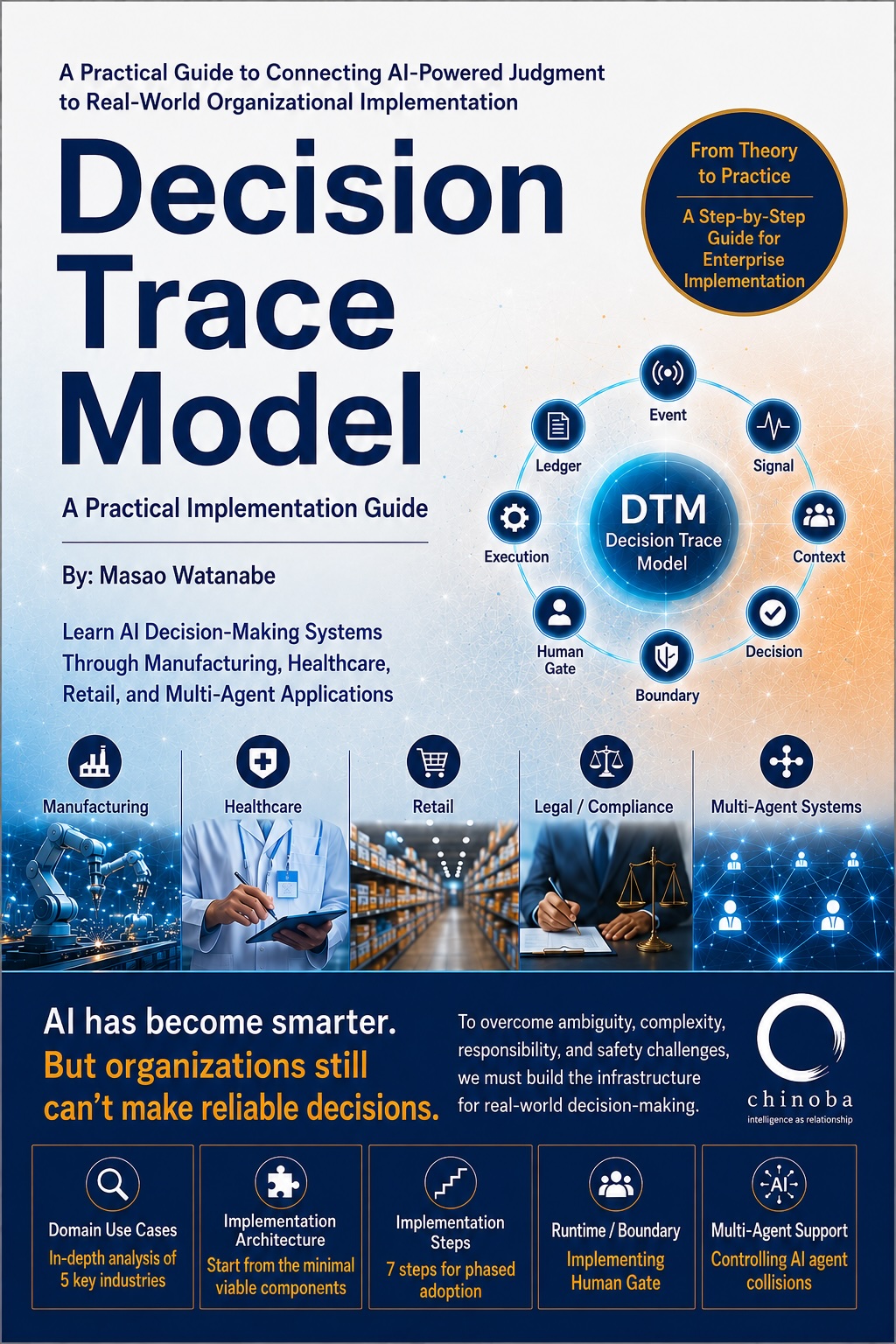
Available on Kindle →A practical guide for engineers and architects building coordinated, traceable multi-agent systems — from boundaries and gates to runtime traces.
Available on Kindle →Runtime primitives, coordination infrastructure, decision memory, and trust infrastructure for coordinated decision systems.
Forthcoming essays that extend this inquiry into shared context, resonance, runtime coordination, decision traces, and the trust through which distributed agents become collective intelligence.
How a common memory of state and signals becomes the connective tissue that lets distributed agents reason together.
Why shared context, when aligned, makes coordination compound — and why misalignment makes agents cancel each other out.
How a coordination runtime decides who acts, when, under what constraints, and how conflicts are resolved.
How decision traces preserve intent, signals, boundaries, and approvals as the institutional memory of coordinated systems.
Why trust is earned across traced decisions rather than assigned — and how it becomes infrastructure for coordination.
How coordination, not multiplication, turns specialized agents into intelligence that no single agent could hold.
A comprehensive guide to how AI systems evolve from standalone agents into coordinated multi-agent architectures with orchestration, boundaries, and runtime governance.
How AI agents begin forming economic coordination structures through negotiation, task delegation, trust, incentives, and runtime-based governance.