AI no longer only answers. It retrieves knowledge, generates candidates, judges, calls tools, and acts on external systems. Lining up several capable AIs does not, by itself, produce a more intelligent or better-coordinated system.
AI Coordination is the design discipline that aligns the goals, roles, context, authority, responsibility, and outcomes of multiple AI agents, humans, knowledge, tools, organizations, and physical systems into one accountable whole. The central claim of this research is simple to state and hard to engineer: autonomy is not assigned. Autonomy is generated at runtime — decision by decision, from goal, role, permission, context, knowledge, risk, trust, and boundary, resolved into a judgment to act, ask, or stop, and preserved as a Decision Trace an organization can verify afterward.
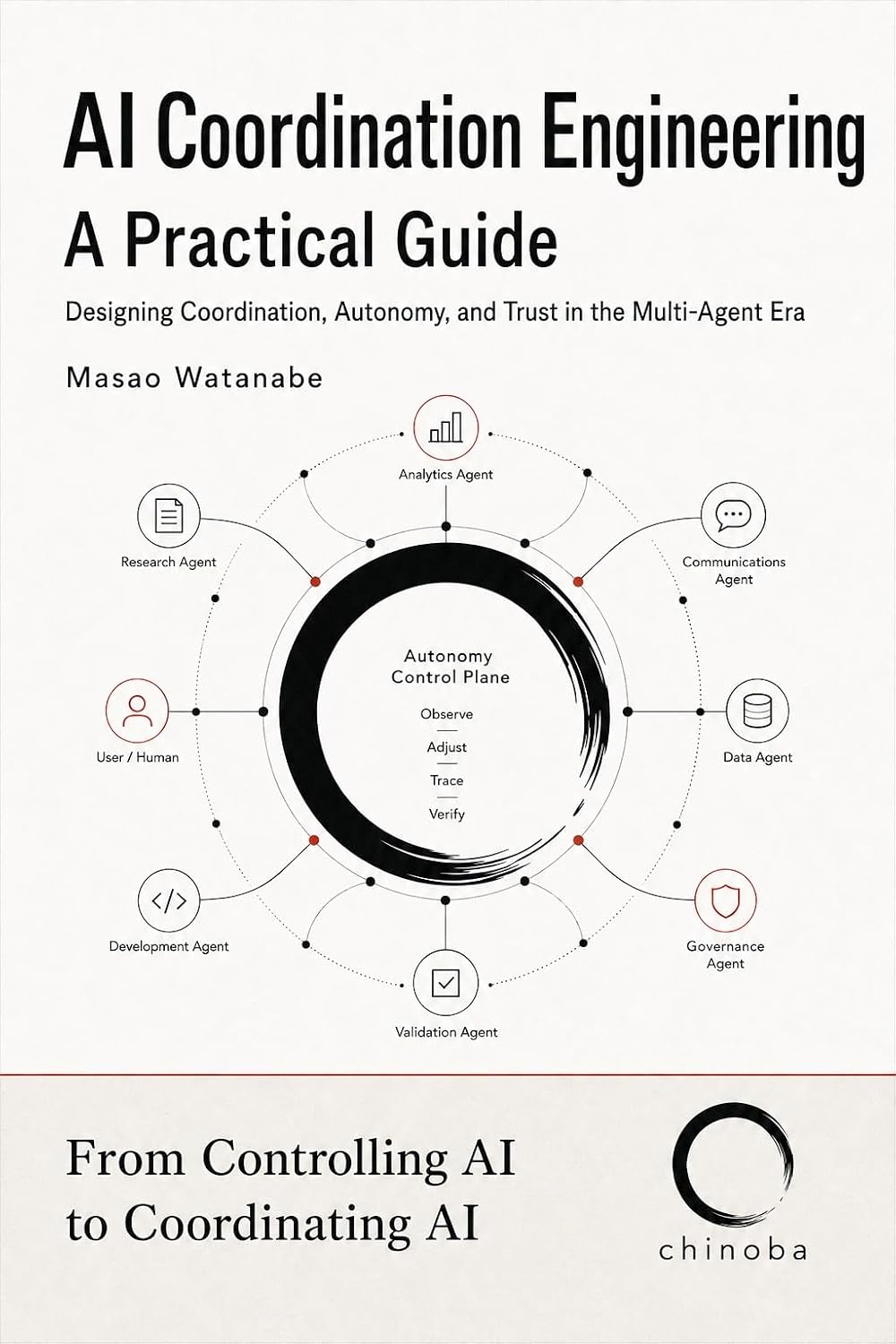
The practical guide behind this page's architecture. It works through why coordination is not communication, how deadlock, race conditions, duplicate execution, and cascading failure grow more dangerous once AI judgment and external execution are involved, how an Autonomy Control Plane resolves Goal, Role, Permission, Context, Knowledge, Risk, Trust, and Boundary into Act, Ask, or Stop, how Delegation Contracts carry authority between agents, and how Decision Trace closes the loop back into coordination.
View on Amazon → ASIN B0HFLQTP1F · Kindle · Masao WatanabeThe practical guide above leads this line of inquiry. Below it are the neighboring Chinoba books, videos, and essays on Multi-Agent Systems, Autonomy Control, Trust Infrastructure, Decision Trace, and Runtime Society that this page draws on.
Neighboring practical guides on the governance, trust, knowledge, and runtime layers that AI Coordination Engineering connects.
Visual introductions to AI Coordination, autonomy control, and the shift from autonomous agents to coordinated runtime systems.
The long-form essays behind this page's argument, on coordination, orchestration, and agent safety as runtime infrastructure.
A single AI Agent can reason, call tools, and execute a task within its own scope. Enterprise systems increasingly distribute that capability instead — across a research Agent, a pricing Agent, a contract Agent, a risk Agent — into a Multi-Agent System. That system is where the coordination problem this page addresses actually begins.
Single Agent
↓ Specialized Agents
↓ Multi-Agent System
↓ Coordination Problem
↓ AI Coordination
↓ Accountable Action
Specialization solves a real problem — narrower scope, reusable roles, parallel execution, separated expertise. It does not, by itself, decide who owns the goal, which Agent acts next, what context is shared, or when a human must intervene. Adding Agents multiplies capability; it does not, on its own, produce coordination.
            Multi-Agent Systems
            = the architecture of distributed,
            specialized capability

            AI Coordination
            = the discipline that aligns that
            capability into accountable action
Multi-Agent Systems provide distributed capability. AI Coordination is what makes distributed capability governable — the subject of the sections that follow.
A compact enterprise example makes this concrete: a customer request passed through a research agent, a pricing agent, a contract agent, and a risk agent before reaching approval.
Customer Request
↓ research-agent
↓ pricing-agent
↓ contract-agent
↓ risk-agent
↓ approval
Each Agent in that chain can be individually competent — accurate research, defensible pricing, careful contract review — and the handoff between them can still fail, because competence at one step says nothing about goal, role, context, knowledge, authority, responsibility, risk, trust, or boundary at the next. That is not a framework problem. It is the AI Coordination problem the rest of this page works through in detail. Such systems are commonly implemented with Agent Frameworks — OpenAI Agents SDK, Claude Agent SDK, AutoGen, LangGraph — which help implement Agents and workflows but do not by themselves resolve the coordination problem addressed here.
Multiple Agents ≠ Coordinated System
Communication ≠ Coordination
Coordination ≠ Decision Authority
Agent Consensus ≠ Organizational Decision
Explore how specialized Agents, OpenAI Agents SDK, Claude Agent SDK, AutoGen, LangGraph, and the Chinoba Decision Runtime fit together in practical Multi-Agent architectures.
A research agent can report "research complete," a policy agent can report "verified," and a review agent can report "approval possible" — every message delivered correctly, none of it malformed — and the resulting action can still be wrong. That is not a communications failure. It is a coordination failure, and no amount of message-broker reliability, retries, or encryption prevents it.
The ability to send and receive messages is necessary for coordination. It is not sufficient. Coordination additionally requires:
Common Purpose
↓ Division of Roles
↓ Situational Awareness
↓ Decision-Making
↓ Authority and Responsibility
↓ Learning from Outcomes
Adding smart agents does not automatically create a smart system. Each agent can perform well when evaluated on its own — and the overall system can still fail, because local optimization is not the same thing as global alignment. The recurring causes are goal conflict, context inconsistency, authority conflict, the propagation of incorrect knowledge as if it were verified fact, and coordination cost that eats the gains coordination was meant to produce.
            Every agent can be right on its own terms
            and the system can still be wrong.
            Majority vote settles a tally.
            It does not settle correctness, authority, or safety.

Distributed systems already named these failure modes. What changes when the actors are AI agents is not the name of the failure — it is how much worse each one becomes once judgment, delegated authority, propagated knowledge, and external execution are combined with it.
Two agents each wait on a resource, approval, or answer the other holds. Among AI agents the stall can go unnoticed longer, because each side keeps generating plausible status updates instead of failing loudly. Timeouts, dependency graphs, and a supervisor agent empowered to break the cycle make the wait visible and end it.
Two agents read the same account, contract, or plan and each proposes an update; one decision is silently overwritten, and because both used coherent reasoning, neither looks wrong on its own. Mutual exclusion, optimistic locking, and a coordination policy for resolving conflicting decisions — not only conflicting writes — contain it.
An agent times out and retries a search, order, or email that had already succeeded. Because many AI actions are irreversible outside the system, duplication is not only wasted cost. Idempotency keys, a task ledger recording what has already been attempted, and semantic deduplication of near-identical requests are the containment.
A sent email, a signed contract, or a physical command cannot be undone by a database rollback. The Saga pattern's compensating action is the available substitute, and the more consequential the action, the more it belongs behind a pre-commit Human Gate rather than an automatic retry.
One agent's incorrect conclusion becomes another agent's trusted input, and a single bad decision compounds as it is reused downstream. Fail-safe and fail-closed defaults, circuit breakers that stop calling a degraded agent, and bulkheads that contain a failure to one part of the system keep one error from becoming an organization-wide one.
A naive retry repeats the same flawed reasoning under the same flawed conditions and returns the same wrong answer, more confidently. Exponential backoff, adaptive retry that switches the agent, model, or tool, and checkpoints that allow a genuine rollback turn a retry into recovery instead of repetition.

Autonomy is not one number. It has dimensions — an agent can be highly autonomous in planning and tightly constrained in action — and what an agent is technically capable of doing is not the same as what it is authorized to do in this situation, for this goal, under this permission.
Autonomy is decomposed along at least six axes, each independently adjustable:
Goal Autonomy
Planning Autonomy
Decision Autonomy
Action Autonomy
Coordination Autonomy
Learning Autonomy
An agent may be technically capable of sending the email, approving the refund, or committing the change — capability is what it can do. Whether it may do so here, now, for this requester and this stated purpose, is authority. Confusing the two is how a correct action becomes an unauthorized one.
            Autonomy is not a reward for age
            or a property fixed to a model.
            It is a range that widens when goal, role,
            permission, context, knowledge, risk, trust,
            and boundary support it — and narrows
            the moment they do not.

The agent executes within a defined scope — goal, role, permission, context, knowledge, risk, trust, and boundary all clear their thresholds, so no escalation is required.
The agent presents its candidates, evidence, and unresolved questions to a human rather than deciding alone, because something about goal, risk, or trust does not clear on its own.
Execution is refused outright. Proceeding would cross a Boundary — and no amount of accumulated trust or operational efficiency reopens that door.
A Boundary is not a policy exception waiting to be argued down. It marks the limits that protect safety, privacy, human rights, and critical assets — limits that hold regardless of how capable, efficient, or previously reliable the agent asking to cross them has been.
A Human Gate is not a rubber-stamp approval click. It is the point where an agent must present its candidate actions, the evidence and reasoning behind them, what remains unresolved, the likely impact if wrong, and the deadline by which a decision is needed — so a human is deciding on the same grounds the agent used, not on trust alone.
Coordination assumes agents can act on a shared understanding of what is true, current, and applicable. That assumption fails quietly whenever knowledge is fragmented, stale, out of scope, or interpreted with a different meaning by each agent that touches it.
Delivering the right knowledge to the right agent means carrying more than content:
A shared memory is not a solved problem simply because it exists. Old task state, another agent's unrelated context, or a stale conclusion left in shared memory can pollute a new decision as convincingly as fabricated information. What to share and what to isolate — context scope and context boundary — has to be a deliberate design choice, not a default.
            If knowledge quality is low,
            autonomy must also be reduced.
An ontology is a semantic contract — a common vocabulary that lets agents agree on what an entity, relation, or event means before they argue about what to do with it. A knowledge graph connects entities, relationships, events, roles, and capabilities, so the context an agent needs is not re-derived from scratch but shared as structure.
Assigning the right work to the right agent draws on an Agent Registry and Capability Profile — what an agent can do, what knowledge and tools it can currently reach, its past performance, its cost and response time, and its current trust for this kind of task. Assignment is a runtime decision, not a static org chart.
Asking another agent to do something is not the same as granting it authority to do so. Treating every request between AI agents as a message rather than a Runtime Artifact is how authority quietly leaks — through redelegation, escalation, and a confused deputy acting on borrowed permission it should never have held.
A Delegation Contract makes authority explicit and bounded — at minimum:
Delegation Contract
├── Purpose
├── Scope
├── Authority
├── Constraints
├── Expiration
├── Responsibility
└── Expected Outcome
Redelegation without a carried-forward contract is how privilege quietly escalates. The confused deputy problem is an agent using authority it was lent for one purpose to serve another. A delegation must be traceable end to end, and it must be revocable — suspended or withdrawn — the moment its purpose, scope, or the trust behind it no longer holds.
            Trust is not a fixed score assigned once.
            It is an expectation about future behavior —
            for this purpose, this role, this context,
            this counterpart, and this impact.

A joint decision made by several agents and a human reviewer does not dissolve responsibility across all of them equally. Even a coordinated judgment needs a human Accountable Owner — someone whose responsibility does not diffuse away simply because the decision was distributed.
The mechanisms above — coordination, autonomy control, knowledge, delegation — are not independent modules. They are layers of a single runtime that every coordinated AI decision passes through, and a loop that every such decision traverses.
Observe
↓ Resolve Context and Knowledge
↓ Generate Candidates
↓ Evaluate Policy, Risk, Trust, and Boundary
↓ Authorize: Act / Ask / Stop
↓ Execute
↓ Trace Outcome
↓ Learn and Re-coordinate
A Decision Trace is not a copy of a model's internal chain of thought, and it is not an operations log. It is the structured record an organization needs to verify, after the fact, what a decision was based on and who was answerable for it:

In each case below, what determines the outcome is not raw model capability. It is whether conflicting goals, stale or wrong knowledge, insufficient authority, and irreversible actions were anticipated — and whether recovery was designed in before, not after, the failure.
Research, proposal, approval, and execution treated as one coordination loop across sales, legal, and finance agents with separated goals and roles — where a stale price list or an unapproved contract exception is caught by policy and a human gate before it reaches a customer, not after.
Planning, coding, review, test, and security agents with change generation kept separate from change application — where authority to touch a repository is staged, and an automatic fix still routes through human approval before it merges.
Support, knowledge, policy, and legal agents integrated around a case rather than a single answer — where contractual commitments and exception conditions are bounded in advance, and misdelivery has a defined recovery path rather than an assumption that responses are always final.
Equipment and safety agents coordinating from demand forecast to purchase order and physical action — where fail-safe defaults and human gates sit in front of irreversible physical actions, because a Semantic Digital Twin can inform a decision but cannot undo a machine command already sent.
Agents from different organizations, under different policies and different trust baselines, delegating work across a boundary — where federated identity, a disclosure scope, and a cross-organization decision trace are what let a failure be traced back to the party responsible for it.
Beyond individual deployments, this research is oriented toward an AI Coordination Maturity Model — from independent AI use, through fixed workflows and role-divided coordination, toward trust-aware, dynamically coordinated systems — and toward what a Runtime Organization and a Runtime Society could become once coordination, autonomy control, and decision trace are treated as infrastructure rather than as features of individual agents. These are directions this research is exploring, not capabilities already deployed.

AI Coordination Engineering is not about increasing how much AI agents do. It is about designing so that the action taken is the action that was needed — with the evidence and the authority behind it, inside boundaries that must not be crossed. When something fails, the design should still show where the judgment branched, how far the consequence reached, and who must recover which state. Chinoba studies how Knowledge Flow, Trust Infrastructure, Autonomy Control, Delegation Contract, and Decision Trace connect into that structure.