Intelligence does not emerge only from isolated models, but from relationships, propagation, and structure.
Graph-based intelligence systems allow AI to model relationships, context propagation, trust structures, decision traces, and organizational knowledge flow.
Enter Graph Intelligence & Relational Systems through video and long-form texts — visual introductions and deeper explorations of Graph Neural Networks, Decision Trace GNN, relational learning, and graph-based intelligence in the age of AI.
Visual introductions to Graph Intelligence, Graph Neural Networks, Decision Trace GNN, and relational learning in the age of AI.
Long-form explorations of Graph Intelligence, Graph Neural Networks, Decision Trace GNN, relational learning, and graph-based decision intelligence. The books have not yet been published.
A relational view of intelligence — where meaning, influence, and decision live between entities, not inside them.
Graph Intelligence refers to AI systems that model:
Many real-world systems
are not isolated entities.
They are relational systems — and their behavior cannot be recovered from the parts alone.
Graph-based architectures enable AI to model interaction, propagation, dependency, and collective structure — the substrate that isolated embeddings tend to flatten away.
Intelligence is not stored in a node.
It is shaped by the edges.
This inquiry treats graph intelligence as a relational layer for decision systems — where organizational memory, trust, and influence become first-class objects of computation.
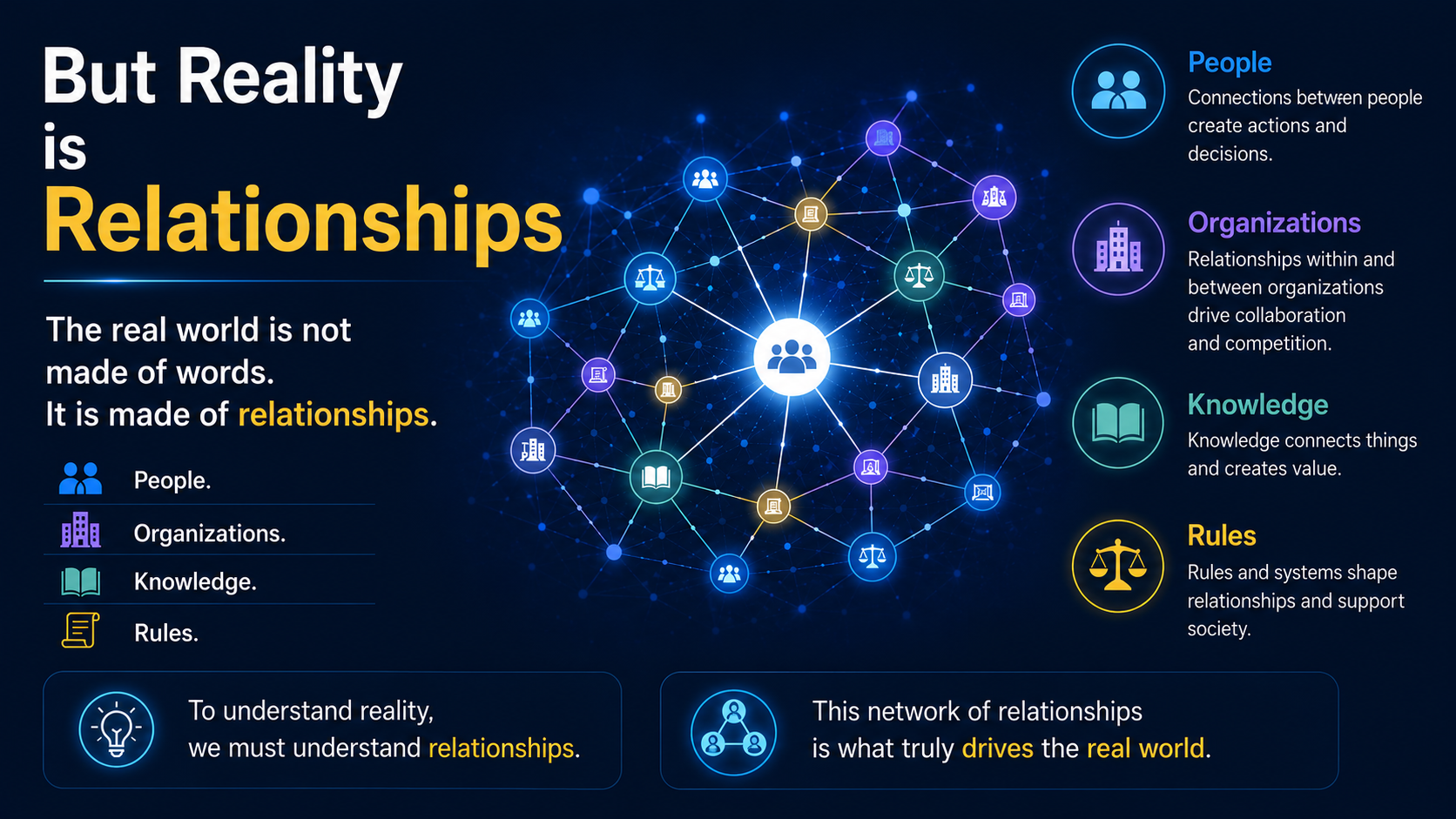
The relational view made concrete: reality is not a list of isolated things but a web of people, organizations, knowledge, and rules bound together. Notice how meaning gathers at the connections, not the nodes — the same intuition graph intelligence encodes when it treats relationships as the primary object of computation.
Real organizational intelligence is relational — and relational structure is exactly what most AI pipelines discard at the input boundary.
Traditional AI often processes information as:
Input → Embedding → Output
This frame is sufficient for many product features. It treats each input as if it were independent of every other.
But organizations — and the decisions inside them — are rarely independent. They carry history, context, and connection.
However, real organizational intelligence contains:
GNNs and graph intelligence systems allow AI to move closer to relational reasoning — to propagate context, not just compress it.
The future of AI may not depend
only on larger models.
It may depend on better representations
of relationships.
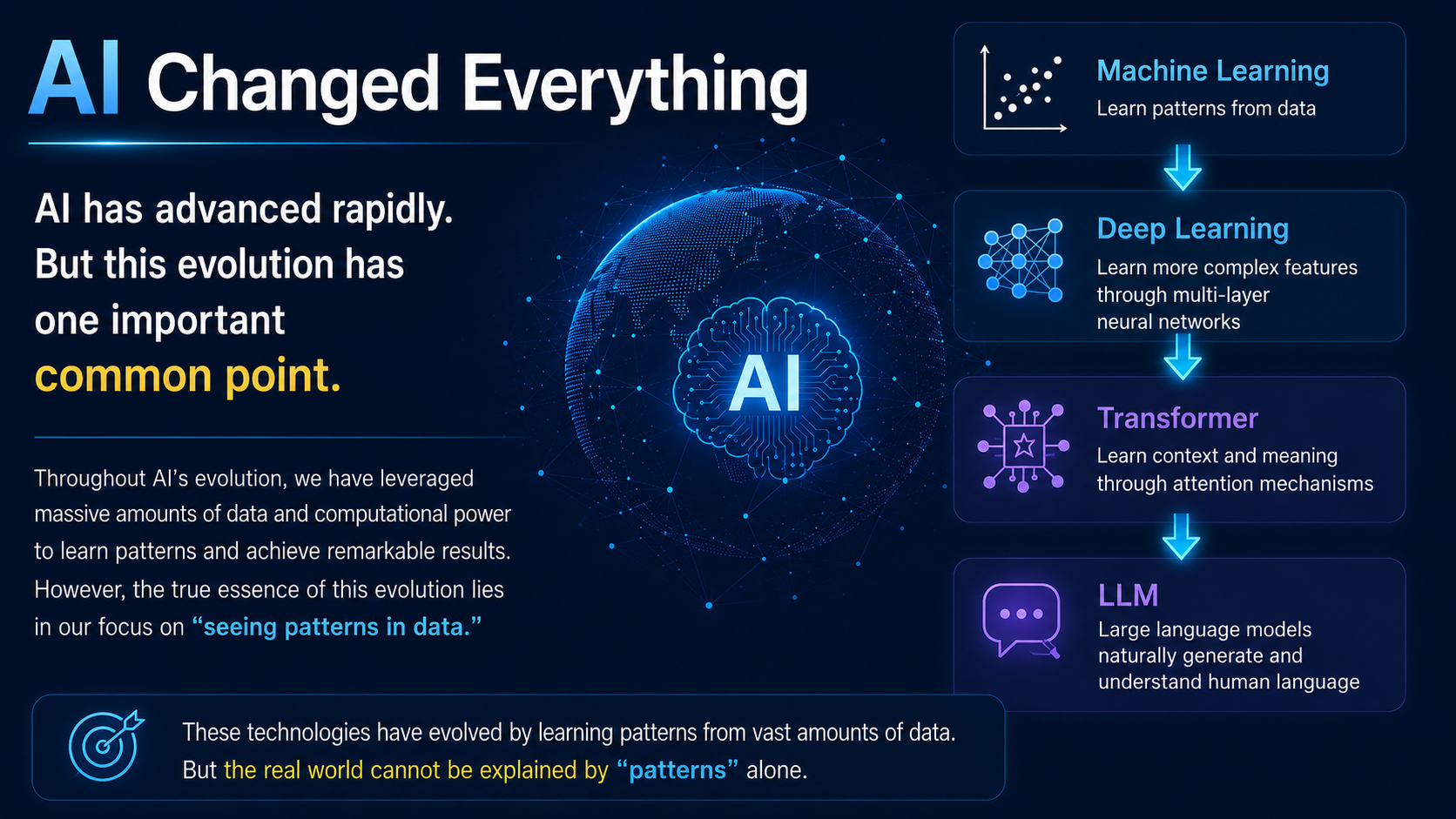
Every wave of AI — from machine learning to deep learning to transformers and large language models — has advanced by finding patterns in ever-larger data. That is a genuine achievement, but it is also a ceiling: the real world is not only a distribution of patterns, and much of what an organization needs to reason about lives in structure that pattern-matching alone cannot recover.
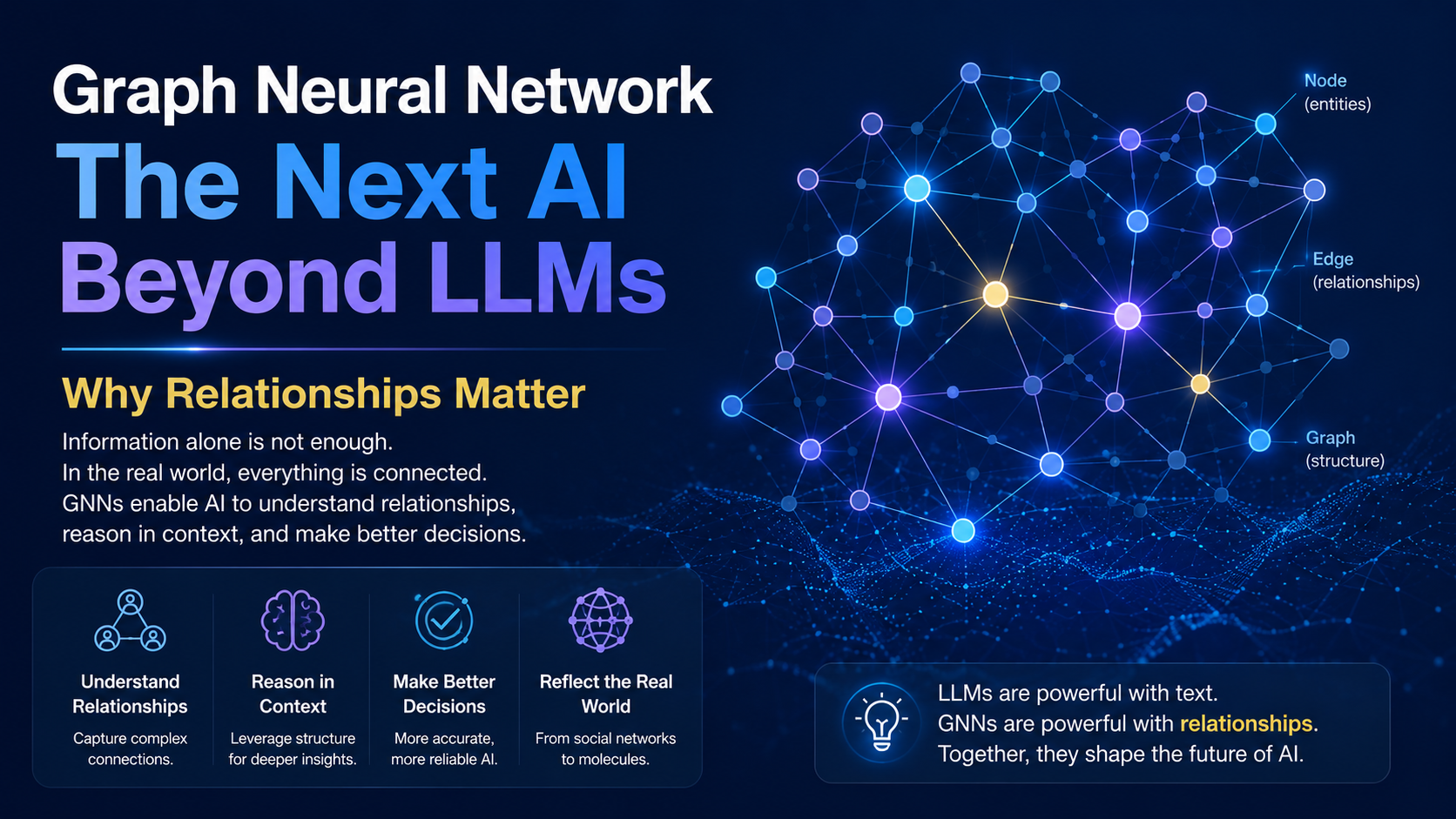
This is the opening for a graph frame. Where language models are powerful with text, graph neural networks are powerful with relationships — representing entities as nodes, their connections as edges, and the whole as a structure that can be reasoned over. The two are complementary, and together they point past the limits of any single larger model.
Eight layers that compose a graph-based intelligence runtime — from nodes and edges to organizational coordination.
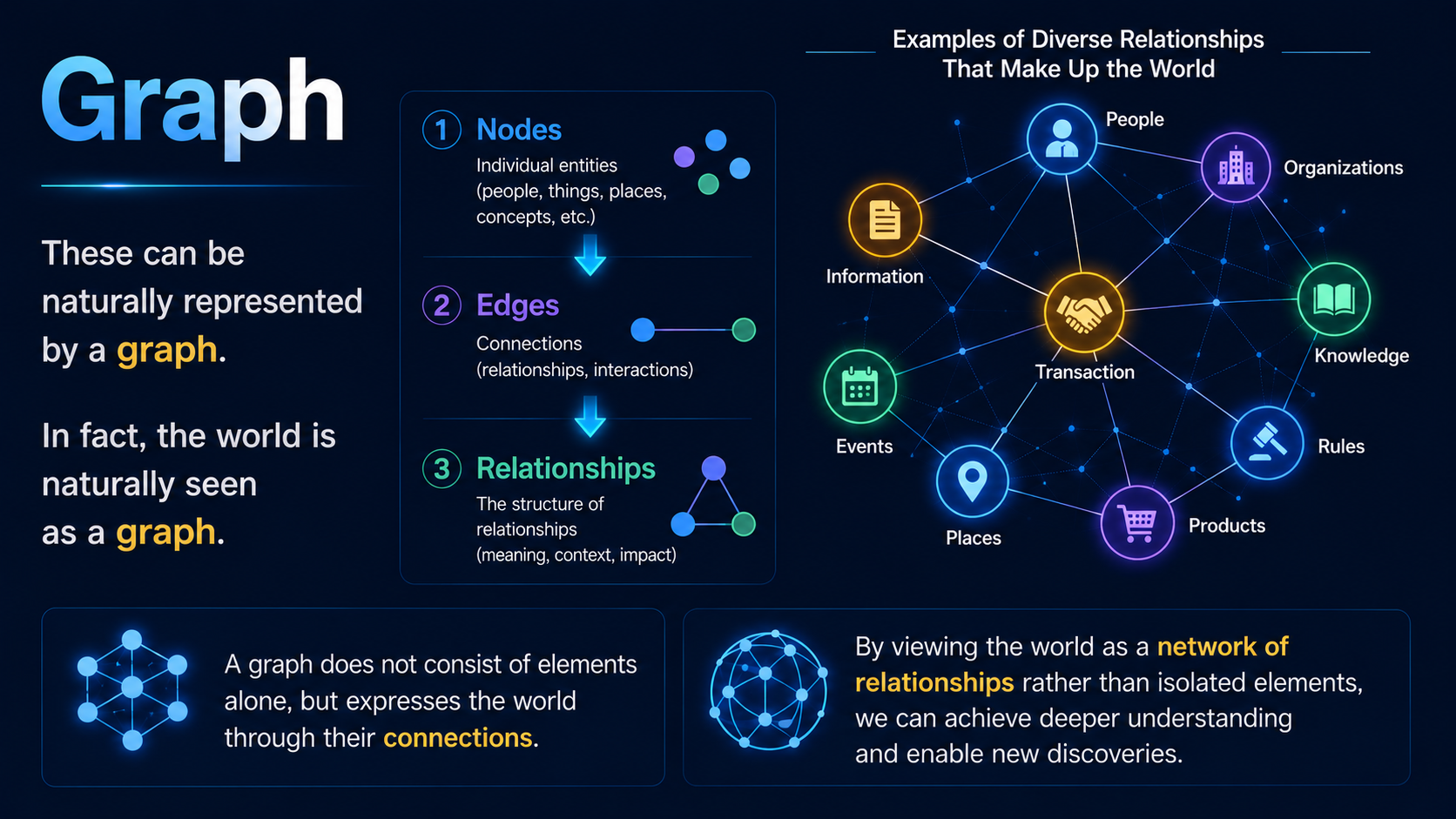
Before the layers, the primitives. A graph is only three things — nodes for entities, edges for the connections between them, and the relationships those edges carry as meaning, context, and impact. Read from left to right: the same three primitives that describe a single relationship also describe an entire world of people, organizations, events, and knowledge linked around a shared transaction.
The smallest unit of representation — an entity, agent, document, or decision endowed with its own state and meaning.
Typed connections between nodes — influence, dependency, citation, trust, escalation — making structure explicit.
How signals, context, and influence travel across the graph — the substrate on which relational reasoning runs.
The meaning carried by topology itself — neighborhoods, motifs, and patterns that encode what a region of the graph is about.
A relational ledger of reputation, verification, and reliability — where trust is a measurable property of connection.
The web of decisions, dependencies, and traces — how a single decision inherits from and conditions others.
The accumulated relational history of an institution — preserved as structure, not flattened into prose.
Live coordination across agents, humans, and systems — the graph as an executable layer for relational decisions.
Graph intelligence gives AI a powerful grip on structure. But structure is not yet meaning — and meaning is what human decisions are made of. This is the gap the Decision Trace GNN is designed to close.
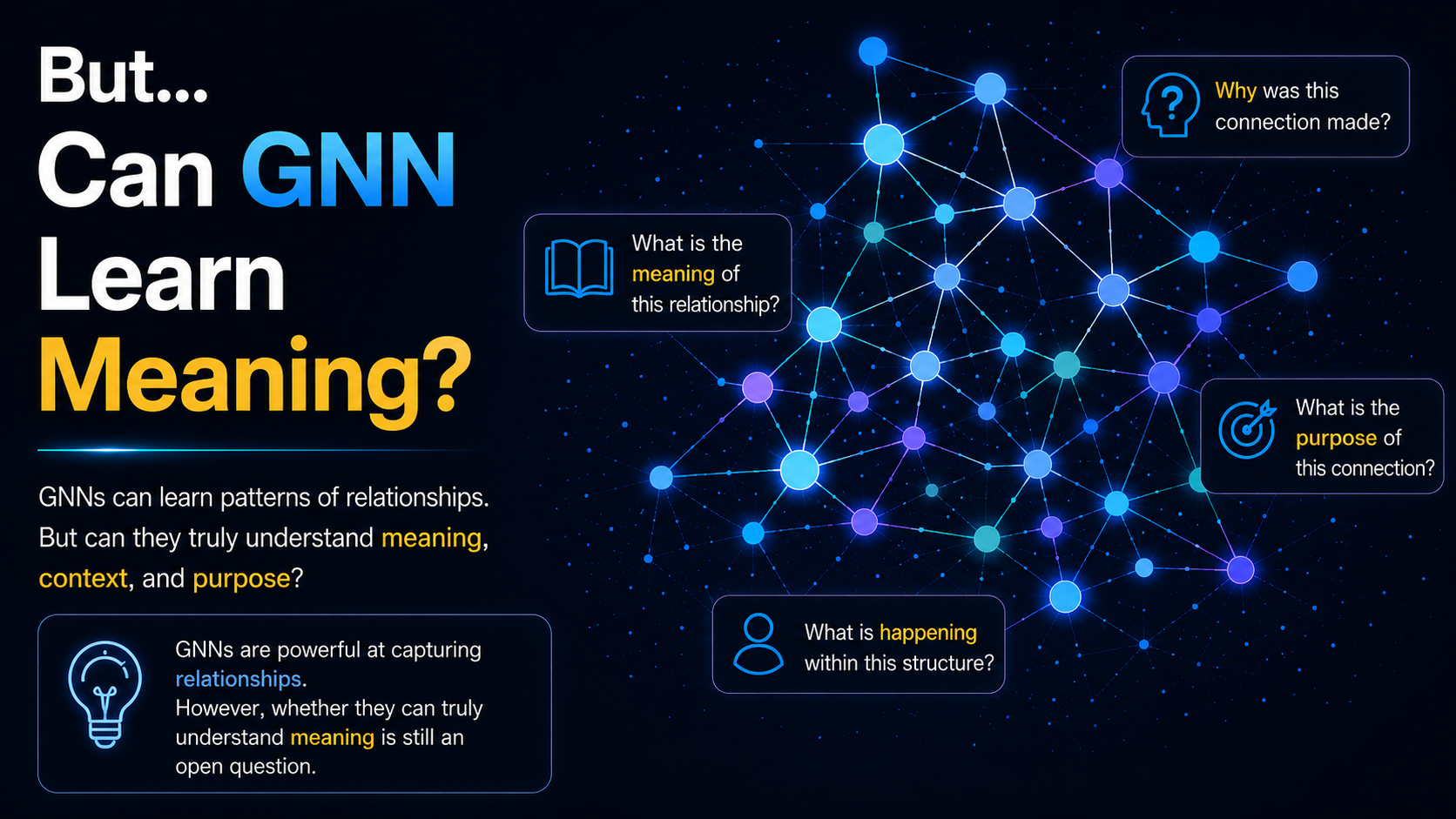
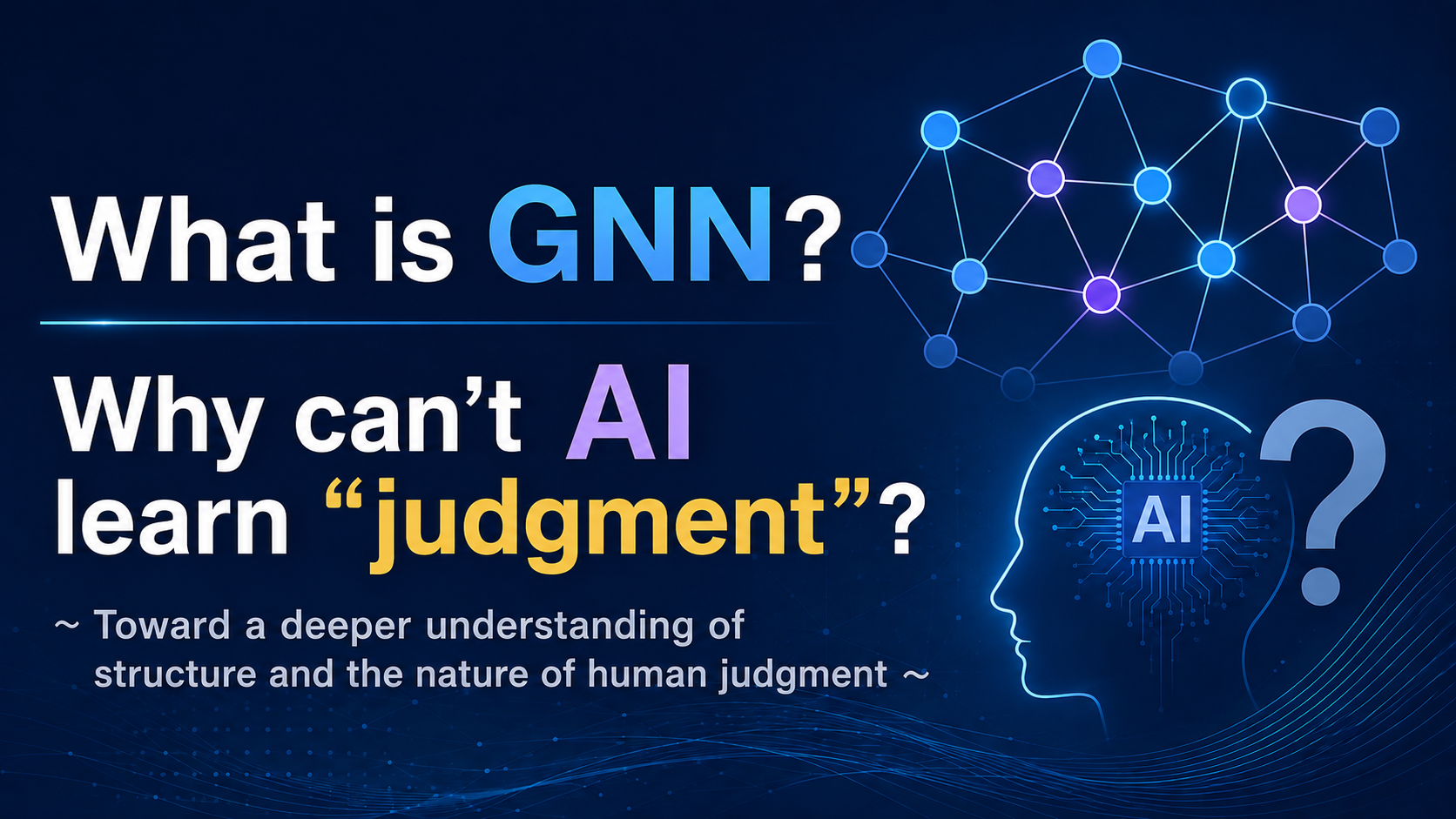
Once a model can read relationships, a harder question follows: can it read what those relationships mean? A GNN can see that two nodes are connected, but not why the connection was made, what it is for, or what is happening inside the structure. These are the questions that separate pattern from judgment.
A graph neural network learns the structure of relationships: which nodes connect, what patterns recur, how strongly and in what role entities relate. That is a great deal — and for many tasks it is enough.
What it does not learn is meaning. The semantics of a connection, its context, its purpose, the background knowledge that tells us what a relationship is about — none of this is present in topology alone.
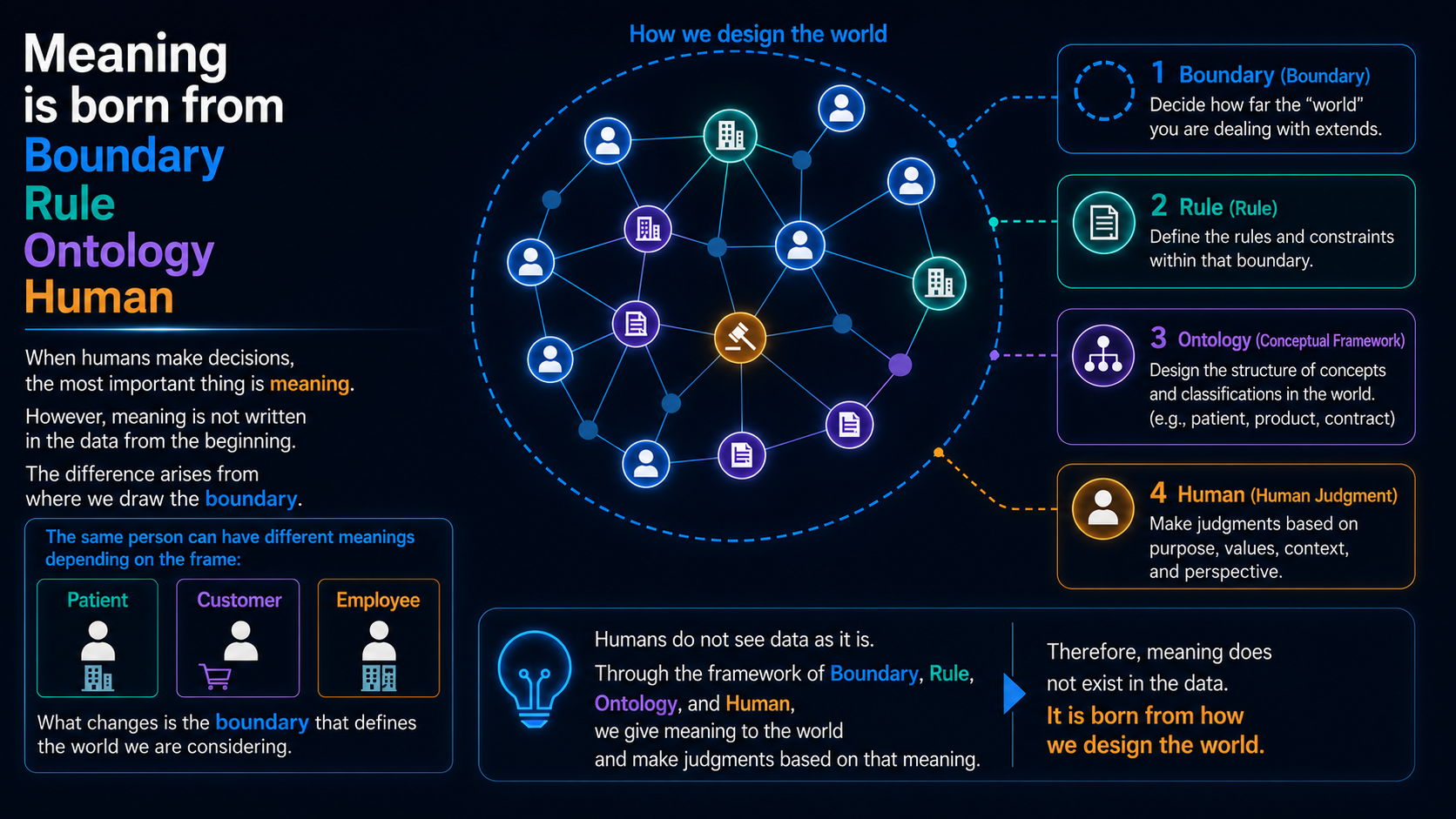
Meaning is not written into the data from the start. It is born from how we frame the world — the boundary we draw around it, the rules and ontology we impose, and the human judgment that reads the same structure through purpose, values, and context.
Meaning does not exist in the data.
It is born from how
we design the world.
The same network of people, organizations, and documents can carry entirely different meanings depending on the frame placed over it. Boundary decides how far the world extends; rules and ontology give it structure; and human judgment supplies purpose. Meaning is a product of that design, not a property of the graph.
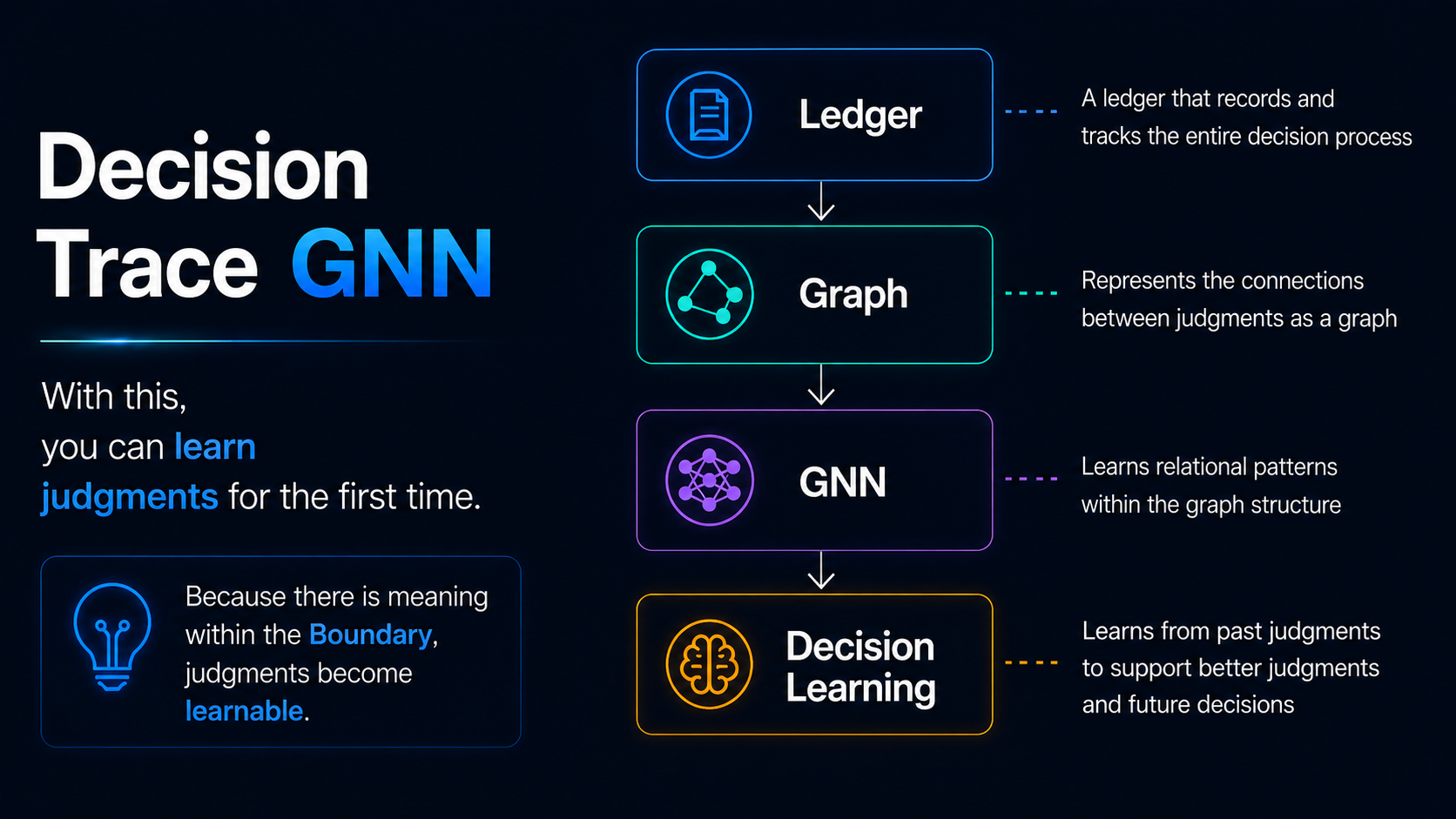
This is where relational learning meets the Decision Trace Model. When decisions are recorded on a ledger, connected into a graph, and given a boundary that fixes what each judgment meant, a GNN can finally learn from them — not the meaning of words, but the structure of judgment itself. Decision Trace GNN turns past decisions into a substrate for better future ones.
Essays that extend this inquiry into GNN-based decision structures, relational reasoning, and the foundations of graph-shaped intelligence.
How GNN architectures can model decision structures, propagation, and organizational runtime behavior.
An exploration of how graph intelligence may bridge semantic discontinuity through relational propagation.
A foundational overview of Graph Neural Networks, their architectures, and applications.
How decision traces, runtime logs, and organizational behavior can become learnable graph assets through ledger structures and GNN-based propagation models.
A forthcoming essay on how graphs operate as a runtime substrate for organizational and agentic AI systems.
Knowledge artifacts that compile the surrounding research into structured volumes. English editions shown here.
A new perspective on AI, relational intelligence, and the relational field within which graph-based intelligence becomes meaningful.
Available on Kindle →A practical guide for designing AI as a decision system — the conceptual frame from which Decision Graph and Decision Trace GNN inherit.
Available on Kindle →The companion practical guide for engineers and architects building decision systems on top of relational and traceable structures.
Available on Kindle →Graph-oriented runtime and intelligence components for relational AI systems.
A growing archive of architectural sketches for graph intelligence, relational propagation, and decision-graph runtimes.
Intelligence is not merely computation. It is the propagation of meaning, relationships, trust, and decisions across connected structures.