Public AI is not only automation. It is a question of decision, accountability, and governance.
As AI enters government, public services, administration, and civic infrastructure, the central issue becomes not only how AI predicts, but how public decisions are made, bounded, reviewed, and traced.
Explore Public AI and Algorithmic Governance through videos and long-form texts — visual introductions and deeper explorations of accountable AI, public decision systems, institutional governance, human-centered AI, and algorithmic governance in the age of intelligent societies.
Visual introductions to Public AI, Algorithmic Governance, AI accountability, and the future of public decision systems.
Long-form explorations of Public AI, Algorithmic Governance, Decision Trace, institutional accountability, policy boundaries, and responsible AI systems.
Public AI is the layer of AI systems used inside institutions whose decisions affect rights, access, fairness, and public trust.
Public AI refers to AI systems used in:
Public AI must not be treated
as simple automation.
It requires decision structures that make responsibility, review, boundaries, appeal, and accountability visible — not optional.
Public AI is often introduced under the framing of efficiency — faster processing, fewer manual steps, reduced administrative load. That framing is not wrong, but it is incomplete.
Public AI is the design of decision
structures inside public institutions —
not the deployment of models inside them.
This inquiry treats public AI as institutional infrastructure: a runtime layer through which public decisions are made, reviewed, and traced.
Public-sector AI is not a productivity tool. It touches the legitimacy of the institutions that use it.
Public-sector AI affects:
Traditional AI systems often focus on a narrow pipeline:
Input → Model → Output
That framing is sufficient for product features. It is not sufficient for public decisions.
Public AI requires a longer chain:
Public Event
↓
Signal
↓
Context
↓
Decision Runtime
↓
Policy Boundary
↓
Human Review
↓
Public Accountability
↓
Trace
In public systems, the problem is not only whether AI is accurate.
The problem is whether AI-assisted decisions
can be explained, challenged, audited,
and governed.
Public AI changes not only how governments process information, but how institutions justify public decisions. The architecture below illustrates the transition: rules and systems that were once designed and operated by humans now embed an algorithmic layer — and the final decision, and its accountability, must remain human.
Eight layers that together compose a public AI decision runtime — from signal to trace.
Events, applications, requests, and observations entering the public system — the raw input of public decisions.
Statutes, regulations, internal rules, and institutional norms that frame what any decision is allowed to mean.
The execution substrate where signals, policy, and AI-generated suggestions are combined into draft decisions.
Limits on what may be decided automatically, what must be paused, and which rights cannot be overridden by a model.
A required pause where a human official assumes responsibility — and where a citizen can challenge a decision.
Mechanisms for oversight bodies, auditors, and the public to inspect how a decision was made and by whom.
Structured, durable records of decisions — the institutional memory through which legitimacy is reconstructed.
Loops that carry audit findings, appeals, and outcomes back into policy and runtime configuration over time.
Read from top to bottom, algorithmic governance is a chain, not a box: society sets the rules, rules constrain the algorithms, and the algorithms feed — but do not replace — the decision. Each layer is a distinct institutional concern.
Decision Runtime is not an AI model. It is the institutional execution layer where policy, human responsibility, and AI recommendations converge before any public action is taken. The public-safety example below shows the pattern: data is analysed into a risk assessment, but the final decision — and the accountability for it — remains with a human.
Every significant public decision should remain replayable, inspectable, and reviewable long after execution. The trace is not a log file — it is the institutional memory through which legitimacy is reconstructed. Auditing closes the loop: decision records are examined for fairness, accuracy, and transparency, and findings feed back into the runtime.
Essays that extend this inquiry into government AI, near-future automation, and the foundational technologies of accountable public systems.
Why government AI can be powerful, but still lacks a designed decision layer, boundary structure, and accountability runtime.
A reflection on how AI, agents, automation, and social systems are rapidly moving from speculative fiction into near-future reality.
Foundational technologies for protecting, compressing, and governing data in AI-enabled public systems.
From public opinion observation to social coordination runtime — exploring how AI, coordination systems, and intelligence fields may reshape governance beyond traditional democratic structures.
A forthcoming essay on shutdown, override, boundary enforcement, and human authority in agentic AI systems.
Knowledge artifacts that compile the surrounding research into structured volumes. English editions shown here.
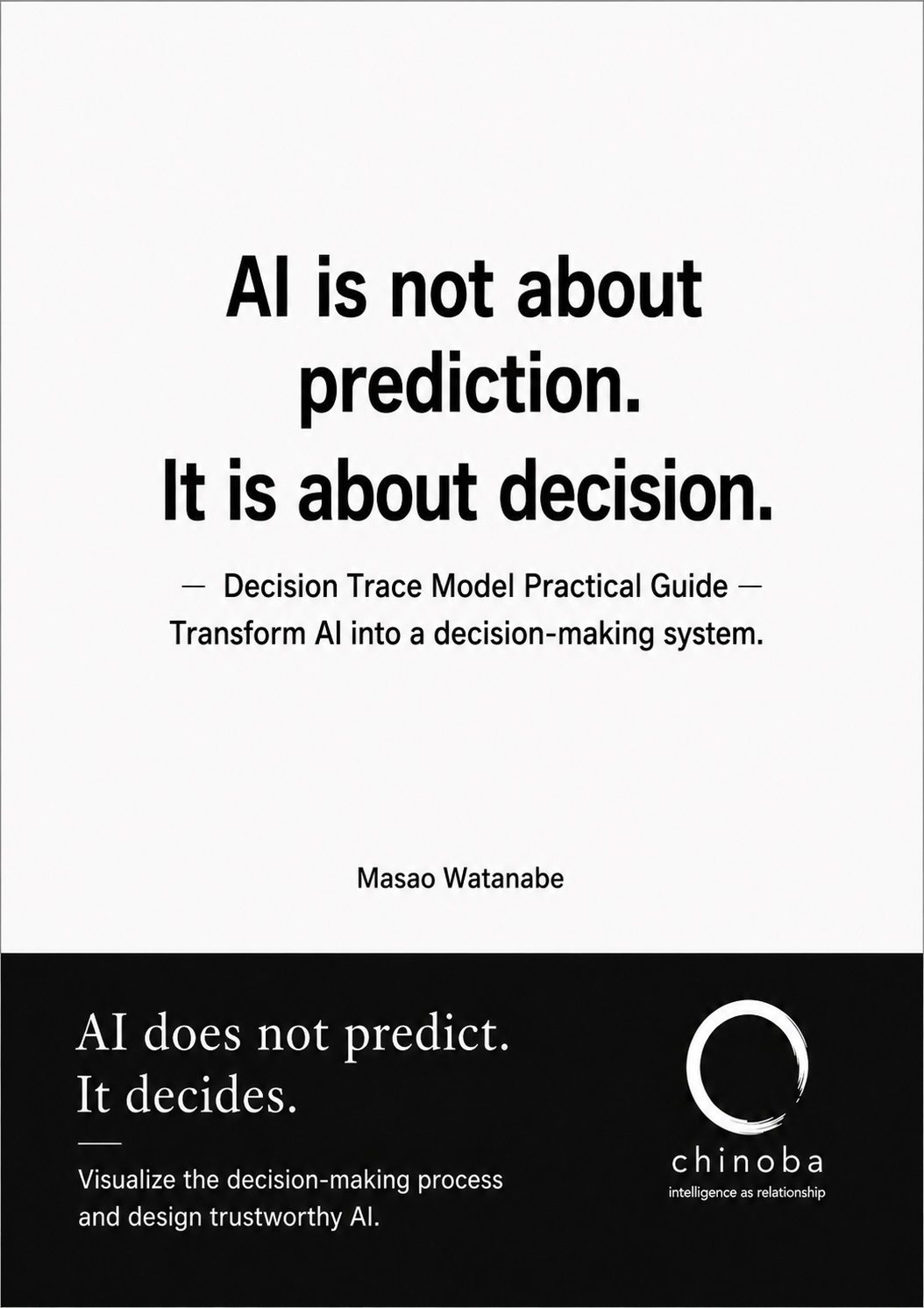
A practical guide for designing AI as a decision system rather than a predictive output engine — the conceptual frame this public AI inquiry inherits from.
Available on Kindle →A new perspective on AI, relational intelligence, and the institutional field within which public decisions are made.
Available on Kindle →Runtime and trace-based components for accountable AI decision systems.
A growing archive of architectural sketches for public AI, algorithmic governance, and accountable decision runtimes.
Public AI is not merely a matter of automation. It is the design of decision boundaries, human review, accountability, appeal, and institutional memory inside public systems.