AI is changing not only software, but the physical architecture of computation.
As AI shifts from large language models to multi-agent and runtime-based systems, hardware, semiconductors, interconnects, memory, and infrastructure layers must also evolve.
Enter AI Infrastructure & Hardware through video and long-form texts — visual introductions and deeper explorations of semiconductor architecture, communication-centric computing, chiplet technologies, and distributed intelligence for the AI era.
Visual introductions to next-generation AI hardware, semiconductor architecture, and distributed intelligence.
Long-form explorations of semiconductor architecture, communication-centric computing, distributed AI, and hardware infrastructure for the next generation of intelligent systems. The books have not yet been published.
AI infrastructure is no longer only about faster GPUs. It spans semiconductors, interconnects, memory, edge compute, and runtime-oriented hardware layers.
For most of its history, AI infrastructure was described in a single dimension — accelerator performance. More FLOPs, more memory, more parallelism.
That framing is no longer enough. The shape of AI workloads is changing, and with it the shape of the underlying computation.
AI infrastructure is no longer only about faster GPUs.
The next generation of AI infrastructure is composed of architectural concerns that span the full stack — from photonic-electronic integration at the silicon layer to runtime execution at the orchestration layer.
AI infrastructure used to mean racks of accelerators connected to centralized storage. It increasingly means a layered system spanning silicon, interconnect, memory, edge devices, runtime orchestration, and cross-agent coordination.
The next generation of AI requires
not only smarter models,
but new computational foundations.
This inquiry treats infrastructure as a research subject in its own right — a layered architecture that shapes which kinds of intelligence are even possible to build.

The shift from LLMs to multi-agent systems changes the requirements of computation itself.
Conventional AI infrastructure was tuned for:
These workloads concentrate compute at the data center and assume that latency can be amortized over batch boundaries.
Agentic systems require something different:
AI infrastructure becomes part of the decision system itself.
Once agents coordinate across boundaries, the infrastructure stops being a neutral substrate and starts shaping the decision behavior.
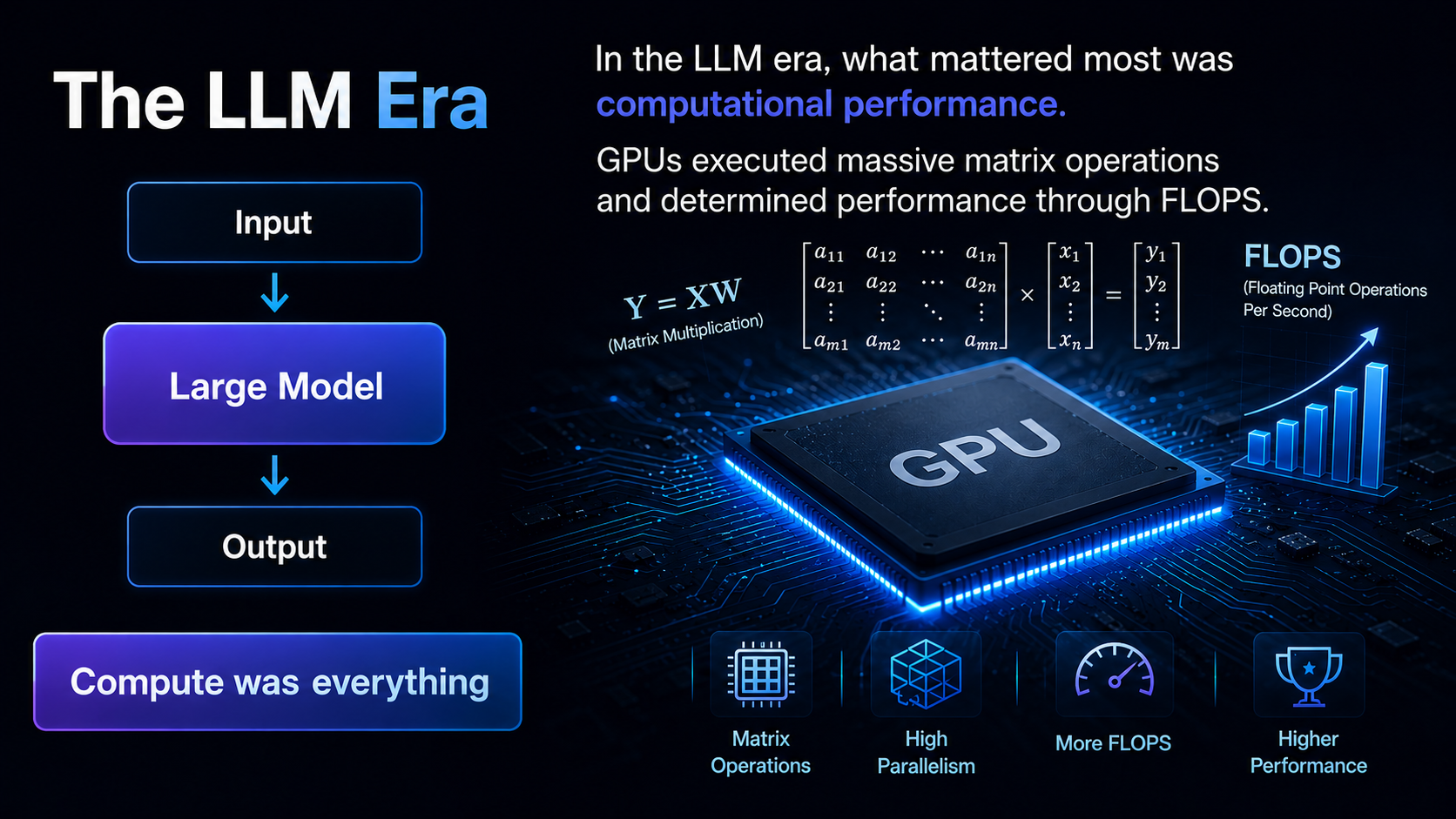
For the LLM era, the design goal was singular — raw computational performance. A large model turned input into output, GPUs executed massive matrix operations, and the winner was whoever could deliver more FLOPS. In that world, compute was effectively everything.
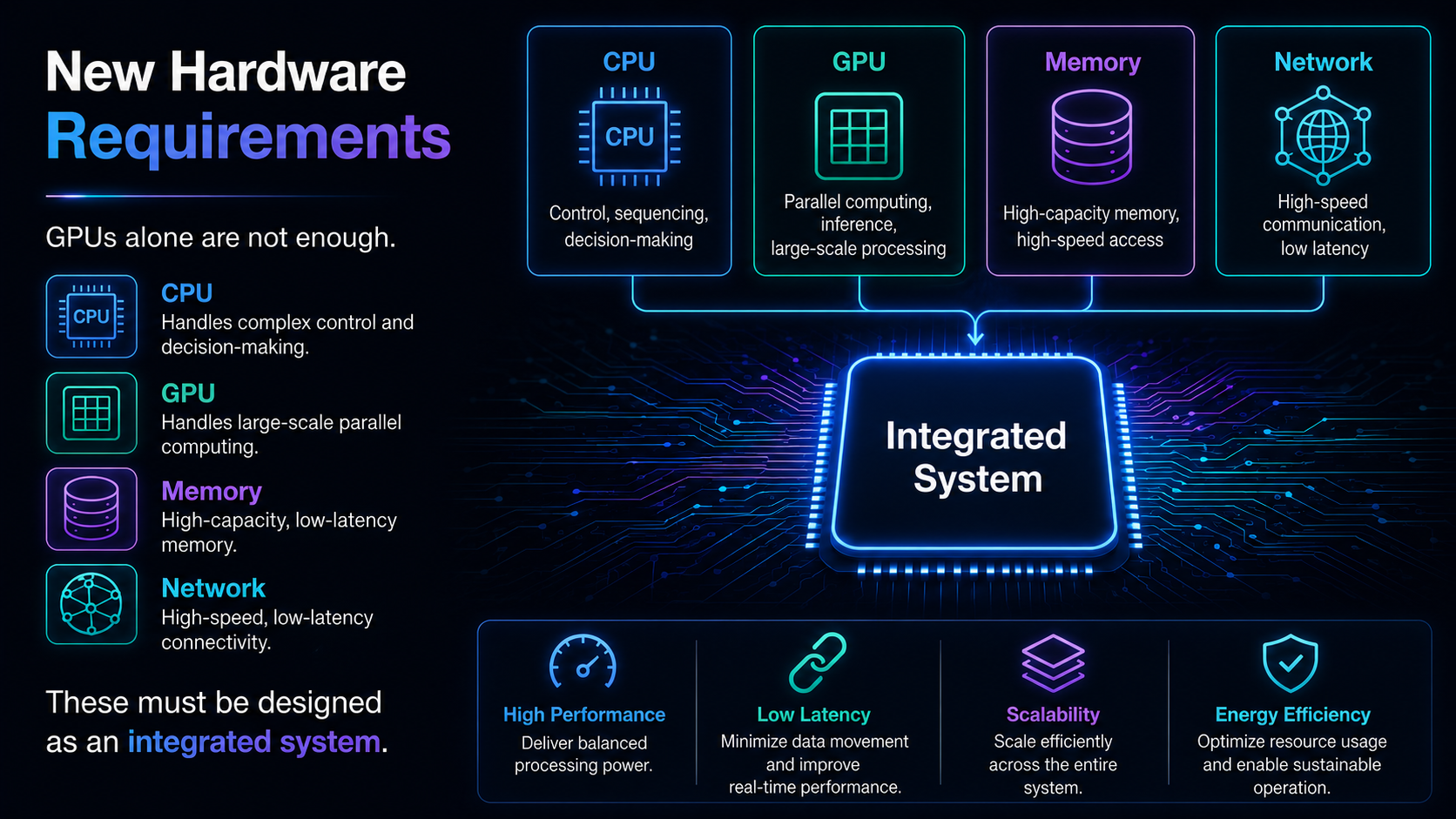
That single dimension is no longer enough. GPUs alone cannot carry multi-agent, runtime-based workloads: they need CPUs for control, high-capacity low-latency memory, and high-speed low-latency networks. The limit of compute-centric design is that these pieces must now be conceived as one integrated system, not a faster accelerator bolted onto everything else.
Eight layers that together compose the AI infrastructure stack for multi-agent, runtime-based systems.
Process nodes, transistor architectures, photonic-electronic integration — the silicon foundation of every layer above.
Interposers, optical links, chiplet fabrics. The wiring that decides whether systems behave as one machine or many.
HBM, near-memory, persistent memory tiers. Memory bandwidth and locality define the ceiling of agentic execution.
GPUs, NPUs, sparse and analog accelerators. The execution engines for both model inference and runtime work.
Distributed deployment surface — edge nodes, regional clusters, cloud back-ends — and the policies that span them.
The orchestration substrate where signals, decisions, and actions are executed under constraints and timing.
Negotiation, routing, escalation, and handoff between agents distributed across the infrastructure.
Structured records of execution — the memory that makes infrastructure auditable, replayable, and accountable.
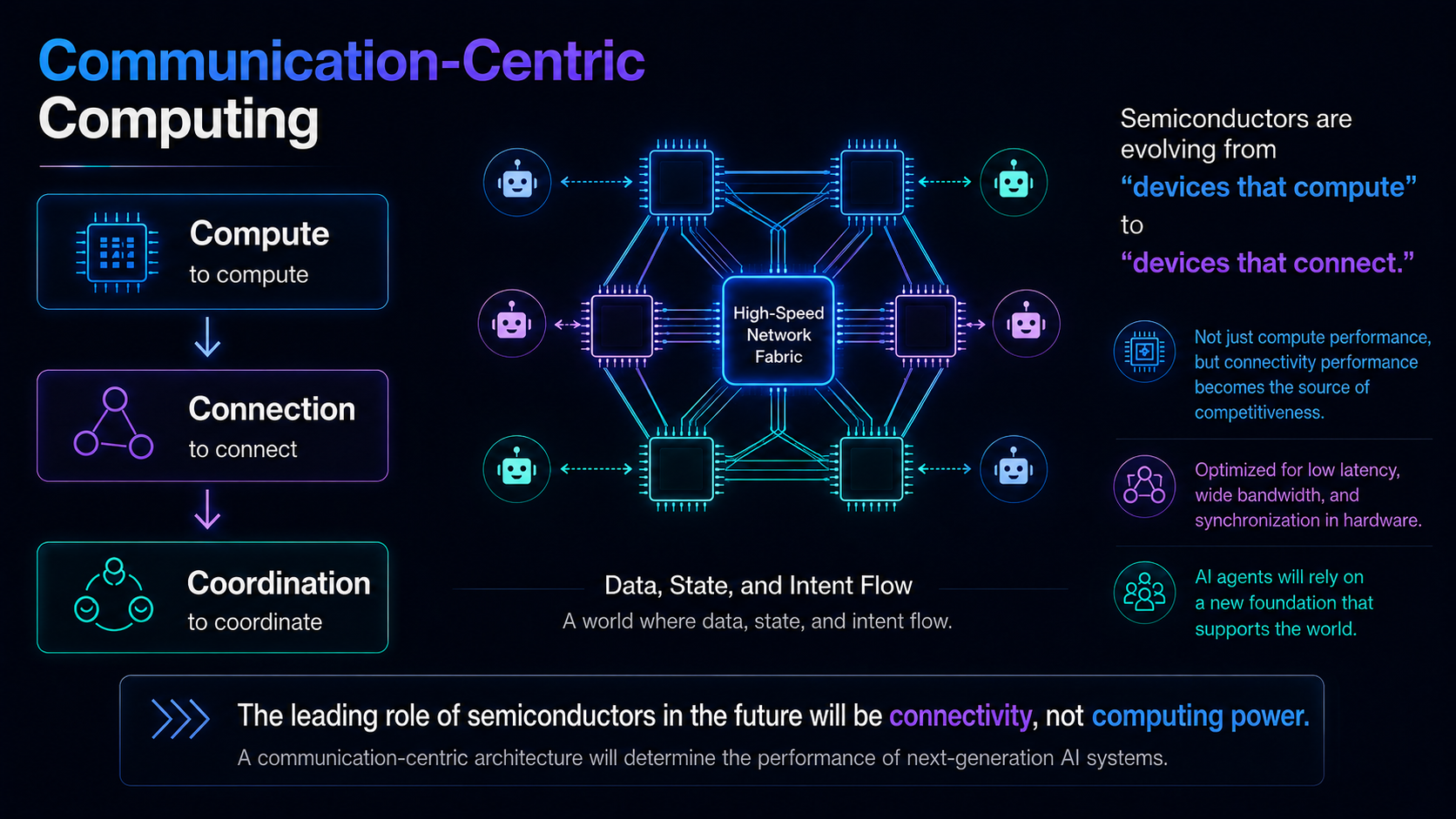
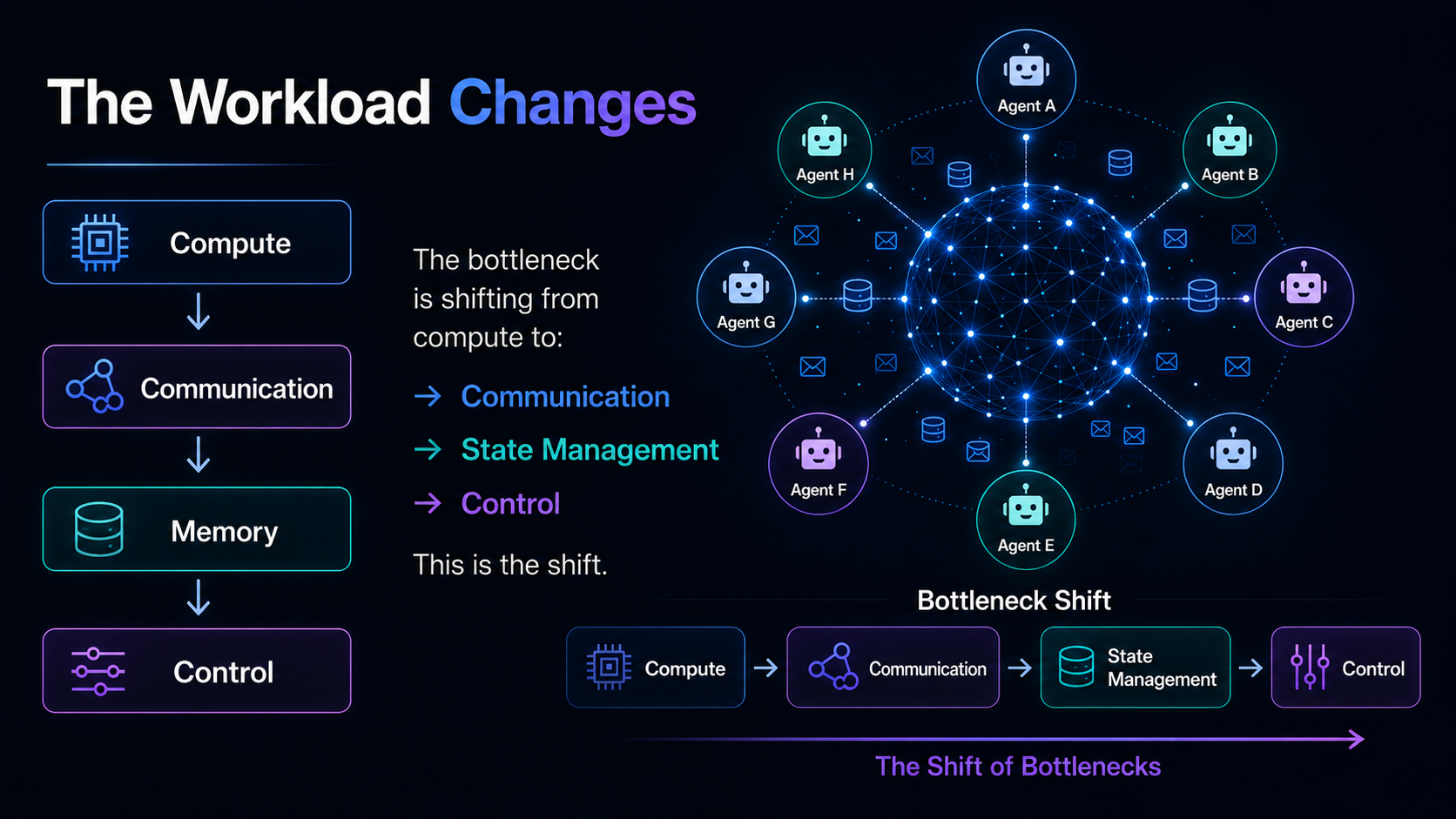
The center of gravity in hardware is moving away from the processor core. When many agents work together, what decides performance is no longer how fast a chip computes, but how well chips connect, share state, and coordinate.
Compute-centric design optimized one thing: the speed of computation inside a chip. Communication-centric design optimizes the flow between chips — and it follows a different sequence.
Computation → Communication → Coordination
Computation still matters, but it is the easy, well-solved part. Communication — moving data and state between processors — is where power and time are now spent. And coordination — many agents aligning on shared state and intent — is the behavior all of this hardware now exists to support.
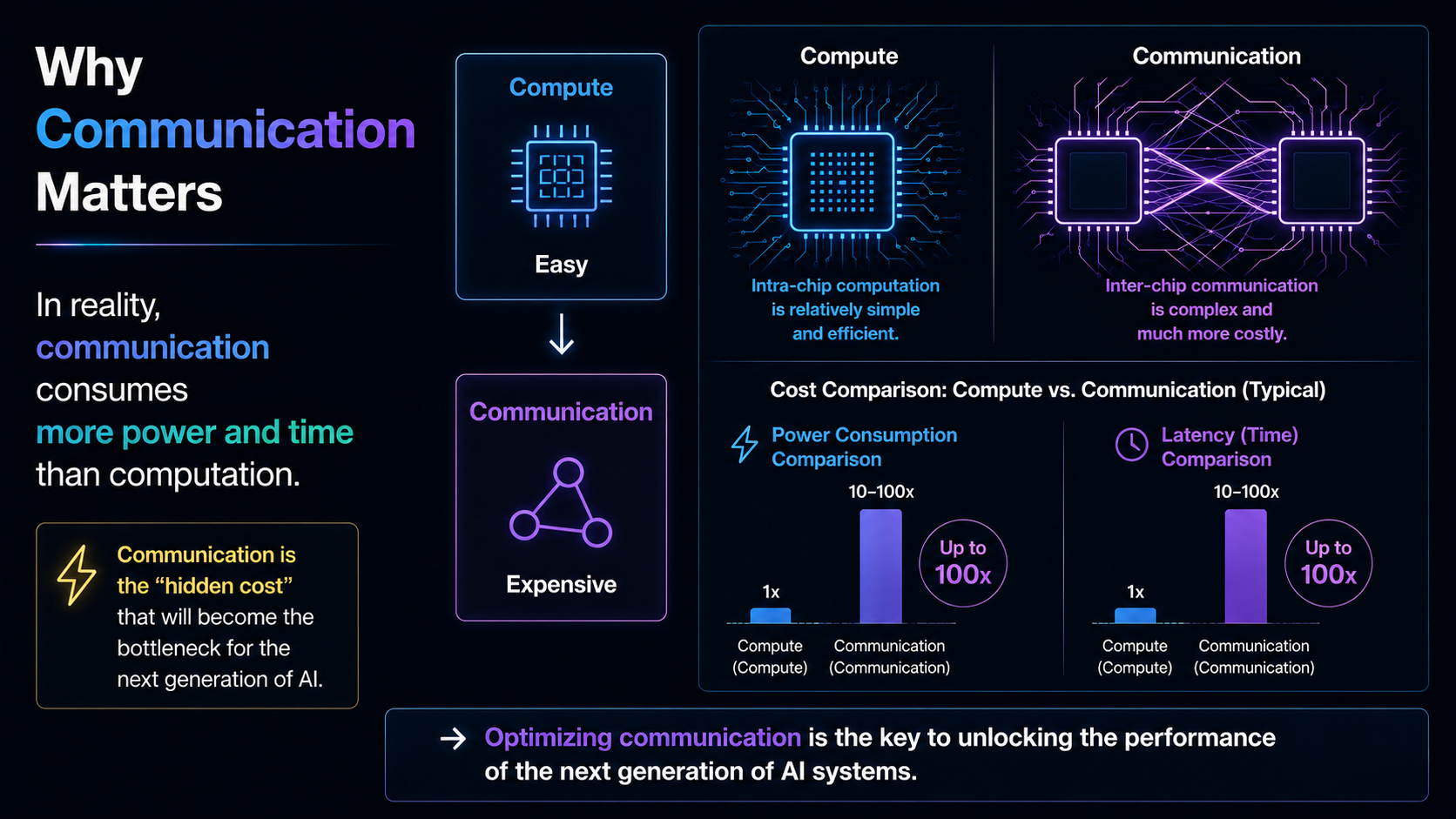
Intra-chip computation is relatively simple and efficient. Inter-chip communication is complex and far more costly — typically 10–100× the power and latency of the compute it connects. That asymmetry is what flips the design priority.
Semiconductors are evolving from
"devices that compute"
to "devices that connect."
The leading role of semiconductors in the coming generation is connectivity, not raw computing power. The chip becomes infrastructure for linking intelligences together, not just an engine for faster arithmetic.
The whole shift on one canvas. The processor's job moves from compute to connect to coordinate; agents surround a high-speed network fabric through which data, state, and intent flow; and the competitive edge passes from computing performance to connectivity performance. This is the picture of communication-centric computing.
Why the priority flips is a matter of cost. Computation inside a chip is cheap and well understood; communication between chips is the hidden expense, consuming on the order of 10–100× the power and time. Optimizing that communication — not adding more raw compute — is the key to next-generation performance.
The same story told as a moving bottleneck. As soon as many agents run together, the constraint slides off the compute core and onto communication, then onto shared state, then onto control. Each arrow marks where the next generation of hardware has to earn its performance.
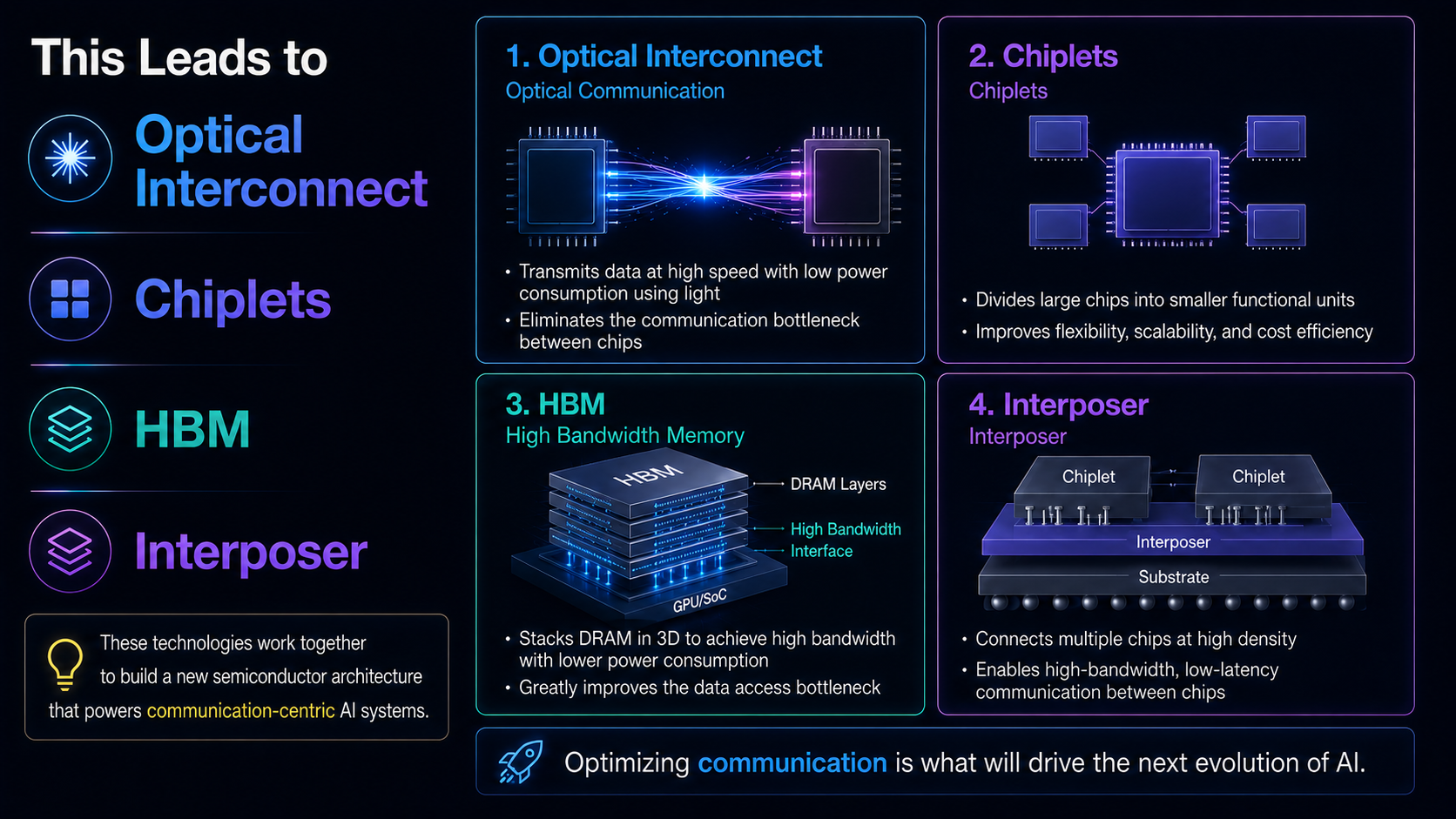
Once communication dominates cost, two hardware problems come to the front: getting data to the compute fast enough, and connecting many specialized dies without paying the full price of moving bits between them.
In agentic workloads the processor is rarely the bottleneck — feeding it is. Compute has outrun the ability of memory to supply data, so what matters is not peak FLOPS but memory bandwidth and the cost of every byte moved.
The bottleneck is not computation.
It is moving data to computation.
A single monolithic die cannot keep scaling. Chiplet architecture breaks one large chip into smaller functional dies and reconnects them at high density — trading the limits of one piece of silicon for a system of cooperating ones.
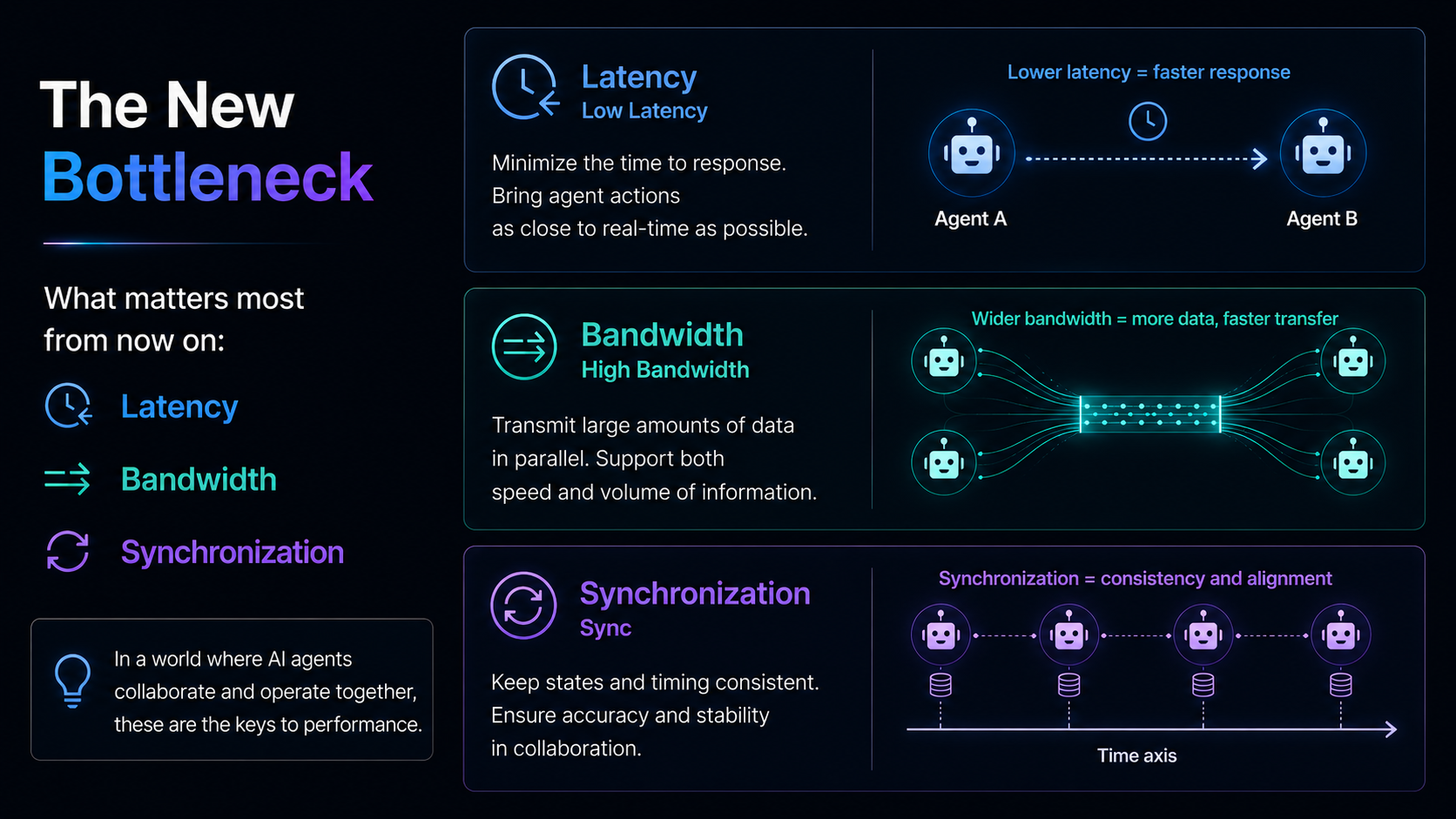
The new performance question is not "how fast is the core?" but "how fast can we reach the data, and how much does the trip cost?" Latency, bandwidth, and synchronization become the metrics that decide whether a fleet of agents runs as one coherent system or falls out of step.
These pressures converge on a single answer at the silicon level. Optical interconnect, chiplets, HBM, and the interposer are not four separate trends — they are one architecture, built so that communication and memory access stop being the thing that holds the system back.
All of these hardware shifts point the same direction. AI is not heading toward a single, ever-larger model — it is heading toward many intelligences that connect, share state, and coordinate. The infrastructure is being built for that destination.
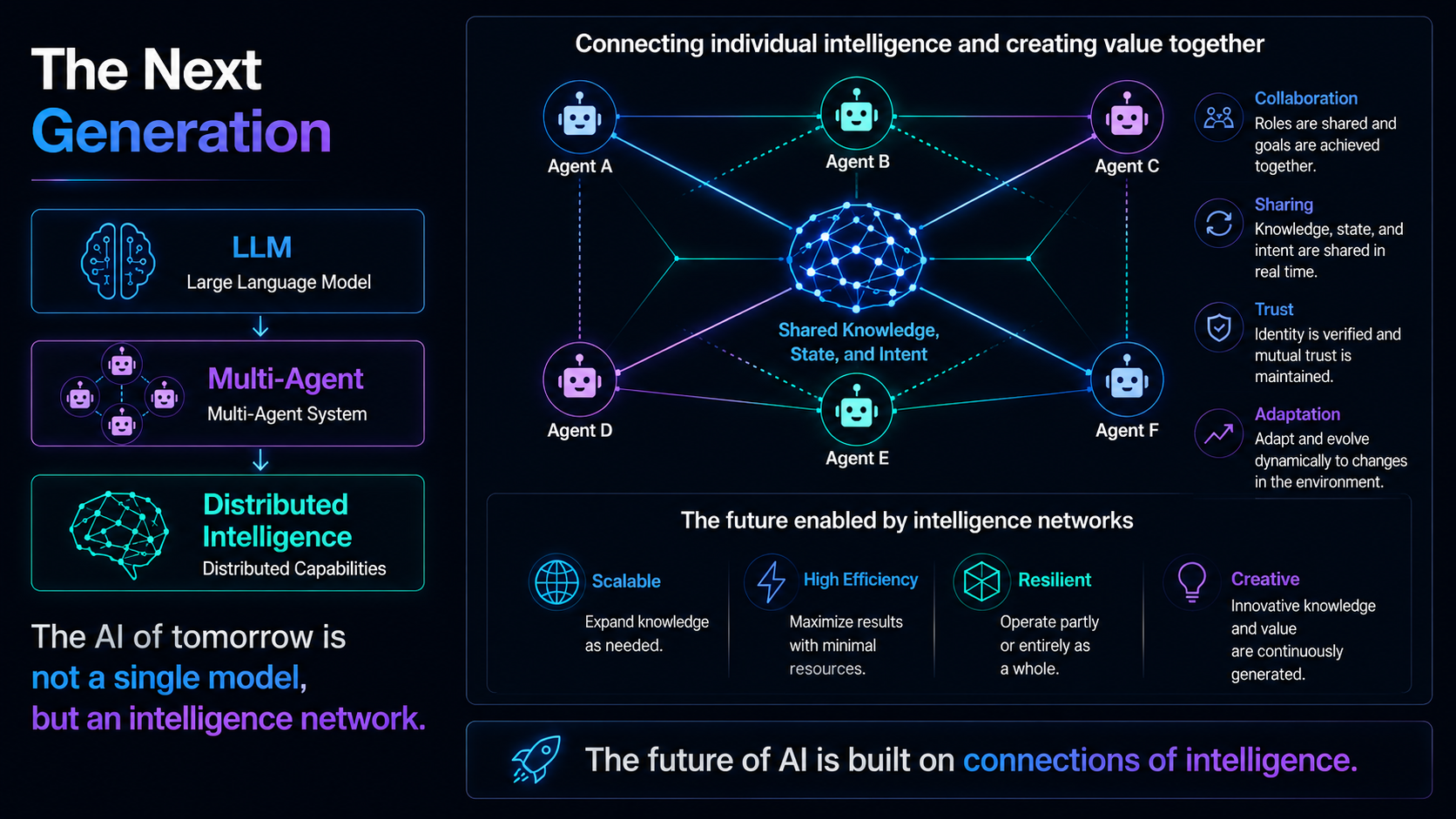
LLM → Multi-Agent → Distributed Intelligence
A large language model is a single mind. A multi-agent system is several minds working in sequence. Distributed intelligence is a network of minds — scalable, efficient, resilient, and creative because capability lives in the connections between agents, not inside any one of them.
The AI of tomorrow is not a single model, but an intelligence network — and a network needs connective infrastructure far more than it needs a faster core.
This is why the semiconductor is being redefined. Its job is no longer to build the fastest possible CPU, but to connect intelligences to one another — to let agents communicate, share state, and coordinate at scale.
The chip is becoming infrastructure
for connecting intelligence,
not an engine for faster arithmetic.
Hardware and coordination become the same design problem: the physical layer exists to keep a distributed system of agents aligned, consistent, and able to act together.
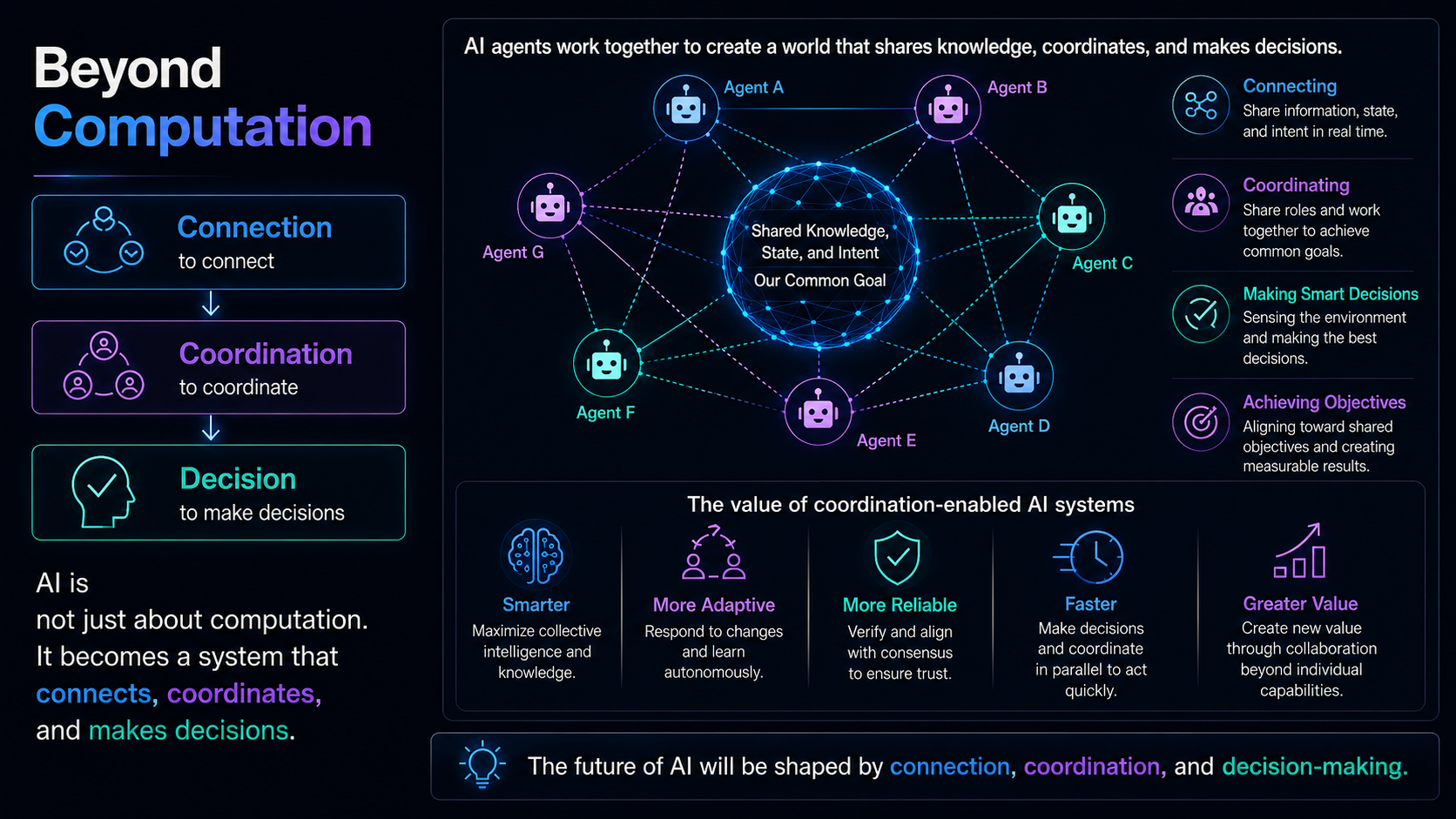
The trajectory in one frame — from LLM to multi-agent to distributed intelligence. On the right, an intelligence network shares knowledge, state, and intent in real time, maintaining trust and adapting as the environment changes. The future of AI is built on connections of intelligence, and the hardware beneath it is being reshaped to carry them.
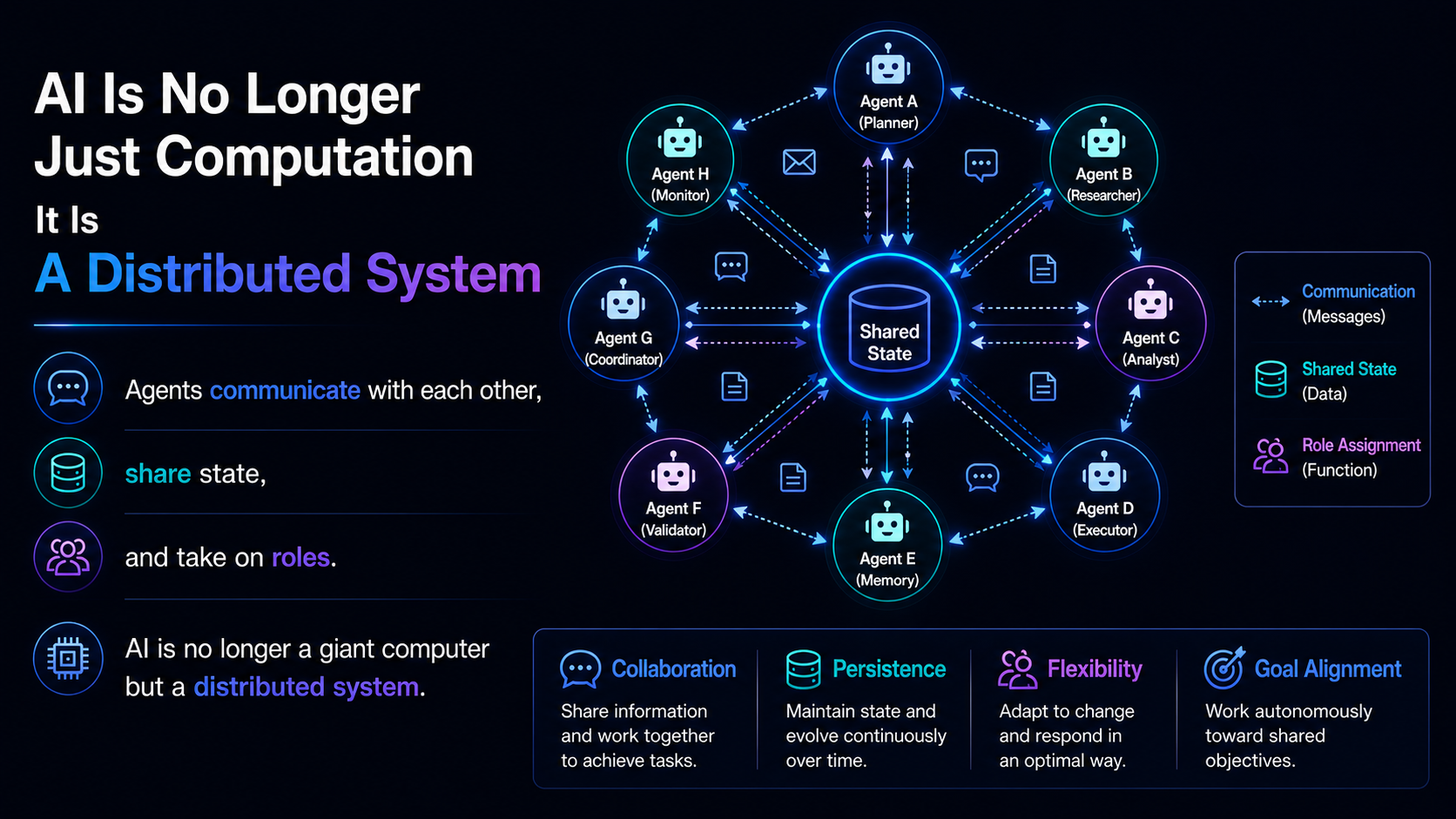
Made concrete: AI is no longer one giant computer but a distributed system, where agents communicate, share state, and take on roles. Collaboration, persistence, flexibility, and goal alignment are properties of the network — and each one is a demand placed directly on the interconnect, memory, and synchronization layers of the hardware.
Essays that extend this inquiry into semiconductors, interposer evolution, and the hardware shift driven by multi-agent AI.
How interposer technology is transforming semiconductors from wiring substrates into integration platforms.
Why multi-agent AI changes the requirements for semiconductor and computation architectures.
A foundational overview of computer hardware architecture and its role in modern computation.
Knowledge artifacts that compile the surrounding research into structured volumes. English editions shown here.
A practical guide for designing AI as a decision system rather than a predictive output engine — the conceptual frame this infrastructure inquiry inherits from.
Available on Kindle →A new perspective on AI, relational intelligence, and the field within which infrastructure decisions are made.
Available on Kindle →Software and runtime components for building decision-oriented AI infrastructure.
A growing archive of architectural sketches for AI infrastructure and runtime hardware structures.
AI infrastructure is no longer a background layer. It is becoming the physical foundation for runtime coordination, multi-agent execution, traceable decisions, and the next generation of intelligence.